


Page 568 - Ultimate Visual Dictionary (DK)
P. 568
THE MODERN WORLD
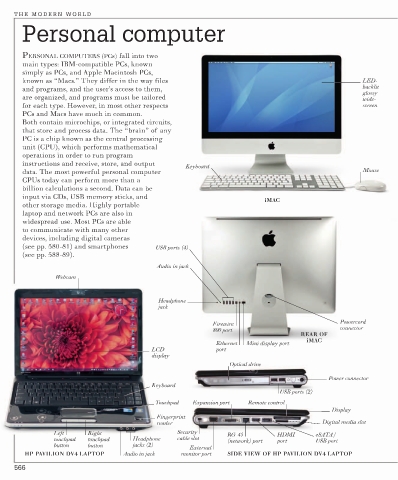
       Personal computer


       PERSONAL COMPUTERS (PCs) fall into two
       main types: IBM-compatible PCs, known
       simply as PCs, and Apple Macintosh PCs,
       known as “Macs.” They differ in the way files                                                  LED-
       and programs, and the user’s access to them,                                                   backlit
                                                                                                      glossy
       are organized, and programs must be tailored                                                   wide-
       for each type. However, in most other respects                                                 screen
       PCs and Macs have much in common.
       Both contain microchips, or integrated circuits,
       that store and process data. The “brain” of any
       PC is a chip known as the central processing
       unit (CPU), which performs mathematical
       operations in order to run program
       instructions and receive, store, and output
                                                     Keyboard
       data. The most powerful personal computer                                                      Mouse
       CPUs today can perform more than a
       billion calculations a second. Data can be
       input via CDs, USB memory sticks, and
                                                                           iMAC
       other storage media. Highly portable
       laptop and network PCs are also in
       widespread use. Most PCs are able
       to communicate with many other
       devices, including digital cameras
       (see pp. 580-81) and smartphones     USB ports (4)
       (see pp. 588-89).
                                             Audio in jack
                Webcam


                                             Headphone
                                             jack

                                                                                               Powercord
                                                            Firewire
                                                            800 port                           connector
                                                                                     REAR OF
                                                                                      iMAC
                                                             Ethernet    Mini display port
                                           LCD               port
                                           display
                                                                 Optical drive
                                                                                            Power connector
                                           Keyboard
                                                                               USB ports (2)
                                            Touchpad   Expansion port  Remote control
                                                                                             Display
                                             Fingerprint
                                             reader                                        Digital media slot
                Left     Right                    Security      RG-45         HDMI       eSATA/
                touchpad   touchpad   Headphone   cable slot    (network) port  port     USB port
                button   button       jacks (2)
                                                      External
        HP PAVILION DV4 LAPTOP     Audio in jack   monitor port  SIDE VIEW OF HP PAVILION DV4 LAPTOP
     566

