


Page 582 - Ultimate Visual Dictionary (DK)
P. 582
THE MODERN WORLD
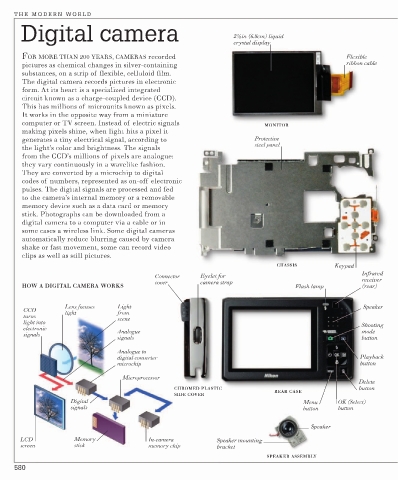
       Digital camera                                             2½in (6.8cm) liquid

                                                                  crystal display
       FOR MORE THAN 200 YEARS, CAMERAS recorded                                                 Flexible
       pictures as chemical changes in silver-containing                                         ribbon cable
       substances, on a strip of flexible, celluloid film.
       The digital camera records pictures in electronic
       form. At its heart is a specialized integrated
       circuit known as a charge-coupled device (CCD).
       This has millions of microunits known as pixels.
       It works in the opposite way from a miniature
       computer or TV screen. Instead of electric signals                  MONITOR
       making pixels shine, when light hits a pixel it
       generates a tiny electrical signal, according to                 Protective
                                                                        steel panel
       the light’s color and brightness. The signals
       from the CCD’s millions of pixels are analogue:
       they vary continuously in a wavelike fashion.
       They are converted by a microchip to digital
       codes of numbers, represented as on-off electronic
       pulses. The digital signals are processed and fed
       to the camera’s internal memory or a removable
       memory device such as a data card or memory
       stick. Photographs can be downloaded from a
       digital camera to a computer via a cable or in
       some cases a wireless link. Some digital cameras
       automatically reduce blurring caused by camera
       shake or fast movement, some can record video
       clips as well as still pictures.
                                                                              CHASSIS         Keypad
                                                                                                     Infrared
                                            Connector    Eyelet for
                                            cover        camera strap                                receiver
       HOW A DIGITAL CAMERA WORKS                                                  Flash lamp        (rear)

                   Lens focuses   Light                                                               Speaker
       CCD         light          from
       turns                      scene
       light into                                                                                    Shooting
       electronic                 Analogue                                                           mode
       signals
                                  signals                                                            button
                                  Analogue to
                                  digital converter                                                  Playback
                                  microchip                                                          button
                                   Microprocessor
                                                                                                     Delete
                                                 CHROMED PLASTIC                                     button
                                                                             REAR CASE
                                                 SIDE COVER
                     Digital                                                         Menu      OK (Select)
                     signals                                                         button    button

                                                                                       Speaker
       LCD            Memory              In-camera          Speaker mounting
       screen         stick               memory chip        bracket
                                                                           SPEAKER ASSEMBLY
     580

