


Page 90 - Ultimate Visual Dictionary (DK)
P. 90
PREHISTORIC EAR TH

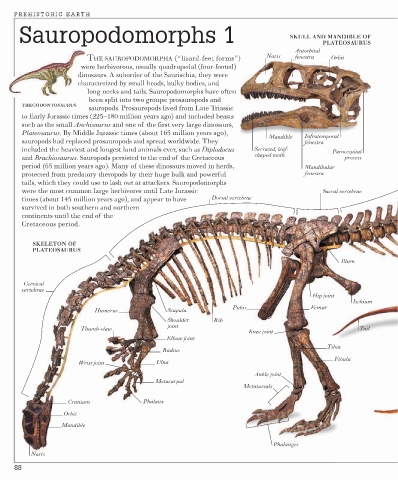
      Sauropodomorphs 1                                                           SKULL AND MANDIBLE OF
                                                                                           PLATEOSAURUS
                                                                                   Antorbital
                         THE SAUROPODOMORPHA (“lizard-feet forms”)         Naris   fenestra  Orbit
                       were herbivorous, usually quadrupedal (four-footed)
                       dinosaurs. A suborder of the Saurischia, they were
                       characterized by small heads, bulky bodies, and
                         long necks and tails. Sauropodomorphs have often
                          been split into two groups: prosauropods and
       THECODONTOSAURUS
                          sauropods. Prosauropods lived from Late Triassic
       to Early Jurassic times (225–180 million years ago) and included beasts
       such as the small Anchisaurus and one of the first very large dinosaurs,
       Plateosaurus. By Middle Jurassic times (about 165 million years ago),
                                                                            Mandible  Infratemporal
       sauropods had replaced prosauropods and spread worldwide. They                 fenestra
       included the heaviest and longest land animals ever, such as Diplodocus   Serrated, leaf-  Paroccipital
       and Brachiosaurus. Sauropods persisted to the end of the Cretaceous   shaped tooth        process
       period (65 million years ago). Many of these dinosaurs moved in herds,         Mandibular
       protected from predatory theropods by their huge bulk and powerful             fenestra
       tails, which they could use to lash out at attackers. Sauropodomorphs
       were the most common large herbivores until Late Jurassic                           Sacral vertebrae
       times (about 145 million years ago), and appear to have   Dorsal vertebrae
       survived in both southern and northern
       continents until the end of the
       Cretaceous period.


          SKELETON OF
          PLATEOSAURUS
                                                                                                Ilium


        Cervical
       vertebrae
                                                                                        Hip joint
                                                                                                   Ischium
                                                                  Pubis                Femur
                           Humerus              Scapula
                                                Shoulder    Rib
                                                joint
                       Thumb-claw                                                                    Tail
                                                                      Knee joint
                                               Elbow joint
                                                                                            Tibia
                                              Radius
                                                                                              Fibula
                       Wrist joint          Ulna
                                                                        Ankle joint
                                            Metacarpal
                                                                     Metatarsals
                    Cranium              Phalanx
                   Orbit
                  Mandible


                                                                             Phalanges
          Naris

     88

