


Page 86 - Ultimate Visual Dictionary (DK)
P. 86
PREHISTORIC EAR TH
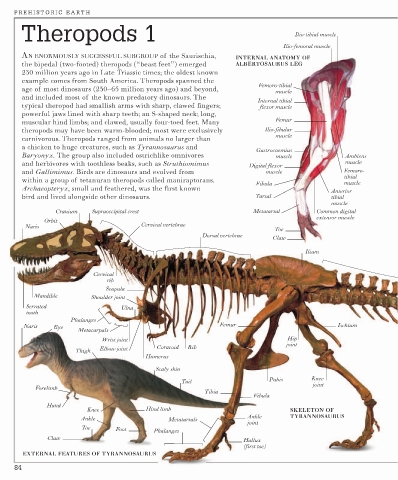
       Theropods 1                                                                 Ilio-tibial muscle


                                                                                Ilio-femoral muscle
       AN ENORMOUSLY SUCCESSFUL SUBGROUP of the Saurischia,       INTERNAL ANATOMY OF
       the bipedal (two-footed) theropods (“beast feet”) emerged   ALBERTOSAURUS LEG
       230 million years ago in Late Triassic times; the oldest known
       example comes from South America. Theropods spanned the
                                                                         Femoro-tibial
       age of most dinosaurs (230–65 million years ago) and beyond,
                                                                              muscle
       and included most of the known predatory dinosaurs. The
                                                                         Internal tibial
       typical theropod had smallish arms with sharp, clawed fingers;    flexor muscle
       powerful jaws lined with sharp teeth; an S-shaped neck; long,
       muscular hind limbs; and clawed, usually four-toed feet. Many          Femur
       theropods may have been warm-blooded; most were exclusively         Ilio-fibular
                                                                              muscle
       carnivorous. Theropods ranged from animals no larger than
       a chicken to huge creatures, such as Tyrannosaurus and
                                                                        Gastrocnemius
       Baryonyx. The group also included ostrichlike omnivores                muscle             Ambiens
       and herbivores with toothless beaks, such as Struthiomimus     Digital flexor             muscle
       and Gallimimus. Birds are dinosaurs and evolved from                muscle                Femoro-
                                                                                                 tibial
       within a group of tetanuran theropods called maniraptorans.
                                                                        Fibula                   muscle
       Archaeopteryx, small and feathered, was the first known
                                                                                             Anterior
       bird and lived alongside other dinosaurs.                        Tarsal               tibial
                                                                                             muscle
                Cranium    Supraoccipital crest                        Metatarsal        Common digital
                                                                                         extensor muscle
             Orbit
        Naris                           Cervical vertebrae
                                                                             Toe
                                                         Dorsal vertebrae
                                                                             Claw
                                                                                      Ilium
                           Cervical
                               rib
                              Scapula
          Mandible        Shoulder joint
        Serrated                   Ulna
        tooth
                     Phalanges
        Naris   Eye                                           Femur                            Ischium
                       Metacarpals
                             Wrist joint                                         Hip
                                                                                joint
                             Elbow joint     Coracoid  Rib
                      Thigh
                                         Humerus
                                            Scaly skin
                                                   Tail                     Pubis       Knee
                                                                                        joint
           Forelimb
                                                          Tibia
                                                                       Fibula
              Hand
                         Knee             Hind limb                               SKELETON OF
                                                                      Ankle       TYRANNOSAURUS
                       Ankle                    Metatarsals
                                                                      joint
                        Toe      Foot       Phalanges
              Claw
                                                                     Hallux
                                                                     (first toe)
       EXTERNAL FEATURES OF TYRANNOSAURUS
     84

