


Page 98 - Ultimate Visual Dictionary (DK)
P. 98
PREHISTORIC EAR TH

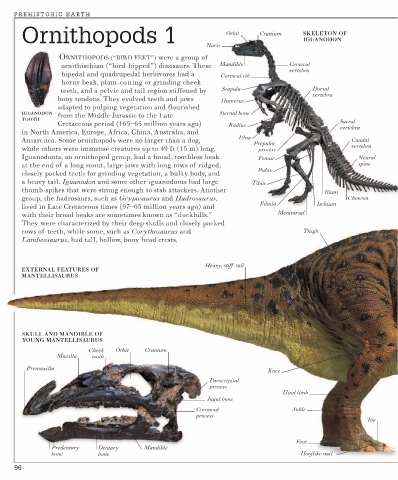
       Ornithopods 1                                            Orbit    Cranium     SKELETON OF
                                                                                     IGUANODON
                                                          Naris
                 ORNITHOPODS (“BIRD FEET”) were a group of
                  ornithischian (“bird-hipped”) dinosaurs. These   Mandible      Cervical
                                                                                 vertebra
                  bipedal and quadrupedal herbivores had a    Cervical rib
                  horny beak, plant-cutting or grinding cheek
                  teeth, and a pelvic and tail region stiffened by   Scapula            Dorsal
                                                                                        vertebra
                 bony tendons. They evolved teeth and jaws    Humerus
                 adapted to pulping vegetation and flourished
       IGUANODON   from the Middle Jurassic to the Late       Sternal bone
       TOOTH                                                                                   Sacral
                 Cretaceous period (165–65 million years ago)    Radius
                                                                                               vertebra
       in North America, Europe, Africa, China, Australia, and
                                                                   Ulna
       Antarctica. Some ornithopods were no larger than a dog,                                     Caudal
                                                                        Prepubic
       while others were immense creatures up to 49 ft (15 m) long.      process                   vertebra
       Iguanodonts, an ornithopod group, had a broad, toothless beak     Femur                      Neural
       at the end of a long snout, large jaws with long rows of ridged,                             spine
                                                                         Pubis
       closely packed teeth for grinding vegetation, a bulky body, and
       a heavy tail. Iguanodon and some other iguanodonts had large    Tibia
       thumb-spikes that were strong enough to stab attackers. Another                     Ilium
       group, the hadrosaurs, such as Gryposaurus and Hadrosaurus,                                Chevron
                                                                         Fibula          Ischium
       lived in Late Cretaceous times (97–65 million years ago) and
                                                                              Metatarsal
       with their broad beaks are sometimes known as “duckbills.”
       They were characterized by their deep skulls and closely packed
       rows of teeth, while some, such as Corythosaurus and                          Thigh
       Lambeosaurus, had tall, hollow, bony head crests.


                                                          Heavy, stiff  tail
       EXTERNAL FEATURES OF
       MANTELLISAURUS


       SKULL AND MANDIBLE OF
       YOUNG MANTELLISAURUS
                          Cheek   Orbit  Cranium
                 Maxilla   tooth

        Premaxilla
                                                                           Knee
                                                           Paroccipital
                                                           process
                                                                                Hind limb
                                                          Jugal bone
                                                       Coronoid                   Ankle
                                                       process
                                                                                                       Toe

                                                                                   Foot
               Predentary   Dentary      Mandible
               bone         bone                                                     Hooflike nail

     96

