


Page 102 - Ultimate Visual Dictionary (DK)
P. 102
PREHISTORIC EAR TH
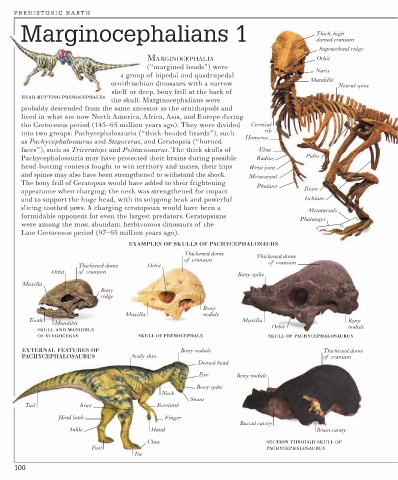
       Marginocephalians 1                                                               Thick, high-
                                                                                         domed cranium
                                                                                          Supraorbital ridge
                                          MARGINOCEPHALIA                                Orbit
                                          (“margined heads”) were
                                                                                         Naris
                                  a group of bipedal and quadrupedal
                                                                                       Mandible
                                ornithischian dinosaurs with a narrow                          Neural spine
                                shelf or deep, bony frill at the back of
       HEAD-BUTTING PRENOCEPHALES
                                the skull. Marginocephalians were
       probably descended from the same ancestor as the ornithopods and
       lived in what are now North America, Africa, Asia, and Europe during
       the Cretaceous period (145–65 million years ago). They were divided   Cervical
       into two groups: Pachycephalosauria (“thick -headed lizards”), such    rib
                                                                     Humerus
       as Pachycephalosaurus and Stegoceras, and Ceratopsia (“horned
       faces”), such as Triceratops and Psittacosaurus. The thick skulls of   Ulna
       Pachycephalosauria may have protected their brains during possible   Radius    Pubis
       head-butting contests fought to win territory and mates; their hips    Wrist joint
       and spines may also have been strengthened to withstand the shock.    Metacarpal
       The bony frill of Ceratopsia would have added to their frightening
                                                                        Phalanx
       appearance when charging; the neck was strengthened for impact                 Ilium
       and to support the huge head, with its snipping beak and powerful              Ischium
       slicing toothed jaws. A charging ceratopsian would have been a
                                                                                       Metatarsals
       formidable opponent for even the largest predators. Ceratopsians
                                                                                    Phalanges
       were among the most abundant herbivorous dinosaurs of the
       Late Cretaceous period (97–65 million years ago).
                                     EXAMPLES OF SKULLS OF PACHYCEPHALOSAURS
                                                    Thickened dome
                                                                        Thickened dome
                                                    of  cranium
                       Thickened dome     Orbit                             of  cranium
               Orbit   of  cranium
                                                                   Bony spike
       Maxilla
                             Bony
                             ridge
                                                         Bony
                                    Maxilla              nodule
         Tooth                                                      Maxilla                       Bony
                Mandible
           SKULL AND MANDIBLE                                                Orbit                nodule
           OF STEGOCERAS               SKULL OF PRENOCEPHALE                SKULL OF PACHYCEPHALOSAURUS
       EXTERNAL FEATURES OF                        Bony nodule                             Thickened dome
       PACHYCEPHALOSAURUS             Scaly skin                                           of  cranium
                                                        Domed head
                                                        Eye        Bony nodule
                                                        Bony spike
                                              Neck
                                                      Snout
        Tail           Knee                  Forelimb
                 Hind limb                     Finger
                                                                    Buccal cavity
                    Ankle                  Hand                                          Brain cavity
                                          Claw                             SECTION THROUGH SKULL OF
                          Foot                                             PACHYCEPHALOSAURUS
                                      Toe

     100

