


Page 326 - The Complete Dog Breed Book Choose the Perfect Dog for You, New Edition (DK)
P. 326
326     C ARE AND TR AINING


        More advanced commands
        Teaching your dog a command that means “stay there and
        wait for me to come back to you” is useful in any number of
        situations. This command works well for everyday use, both
        in the house and on walks, but it can also be helpful in other
        more difficult situations. For example, if your dog escapes
        and runs across a road, you will want him to wait where
        he is rather than recrossing the road and putting himself in
        danger again. Your dog’s natural instinct is to follow you,
        so when you want him to stay in a particular position, it will
        make training easier if you turn sideways to him and avoid
        eye contact. By doing this, he doesn’t think you are
        communicating with him and will therefore be less likely
        to move toward you.
          All dogs need to learn to walk on a leash and must do
        so without pulling, if going for walks is to be an enjoyable
        experience and not a constant battle. Puppies do not
        instantly understand what a leash is for, and it is natural for
        them to pull in an attempt to reach an exciting destination
        sooner. If they learn from the start that pulling on the leash
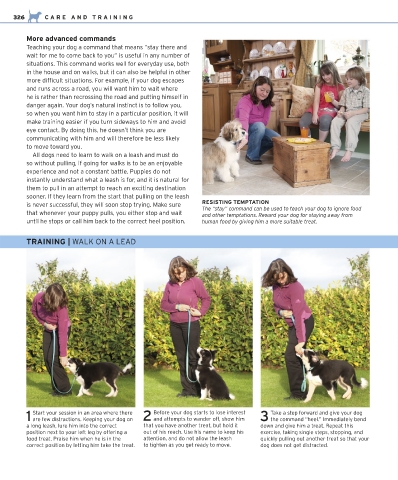
        is never successful, they will soon stop trying. Make sure   RESISTING TEMPTATION
        that whenever your puppy pulls, you either stop and wait   The “stay” command can be used to teach your dog to ignore food
                                                         and other temptations. Reward your dog for staying away from
        until he stops or call him back to the correct heel position.   human food by giving him a more suitable treat.

        TRAINING | WALK ON A LEAD


          Start your session in an area where there   Before your dog starts to lose interest   Take a step forward and give your dog
          ar
           e f
        1    ew distractions. Keeping your dog on  2 and attempts to wander off, show him   3          ommand “heel.” Immediately bend
                                                                            the c
        a long leash, lure him into the correct   that you have another treat, but hold it   down and give him a treat. Repeat this
        position next to your left leg by offering a   out of his reach. Use his name to keep his   exercise, taking single steps, stopping, and
        food treat. Praise him when he is in the   attention, and do not allow the leash    quickly pulling out another treat so that your
        correct position by letting him take the treat.   to tighten as you get ready to move.  dog does not get distracted.


   US_326-327_Wait_Walking.indd   326                                                                10/09/19   3:42 PM

