


Page 332 - The Complete Dog Breed Book Choose the Perfect Dog for You, New Edition (DK)
P. 332
332     C ARE AND TR AINING


        Identifying when your dog is ill
        Different dogs react to illness in different ways. As an owner,
        you know how your dog behaves day to day and are in the
        best position to recognize any changes away from this norm
        as soon as they occur. If health problems are recognized and
        diagnosed early, treatment can start without delay and is
        more likely to have a successful outcome.
          If your dog is in pain, he will probably make this
        immediately obvious by limping or yelping when he moves
        or is handled. Other physical signs of ill health include
        breathing difficulties, such as coughing or heavy panting, for
        no apparent reason. Unusual discharges from the eyes or
        nose are also signs to be noted, as are excessive scratching,
        hair loss other than normal shedding, an unwillingness to
        exercise, or a sudden change in eating or drinking habits.
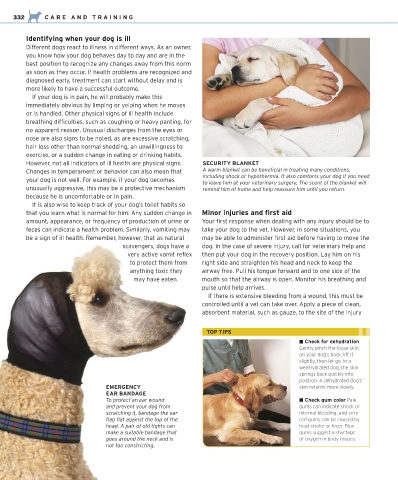
        However, not all indicators of ill health are physical signs.   SECURITY BLANKET
        Changes in temperament or behavior can also mean that   A warm blanket can be beneficial in treating many conditions,
        your dog is not well. For example, if your dog becomes   including shock or hypothermia. It also comforts your dog if you need
                                                         to leave him at your veterinary surgery. The scent of the blanket will
        unusually aggressive, this may be a protective mechanism   remind him of home and help reassure him until you return.
        because he is uncomfortable or in pain.
          It is also wise to keep track of your dog’s toilet habits so
        that you learn what is normal for him. Any sudden change in   Minor injuries and first aid
        amount, appearance, or frequency of production of urine or   Your first response when dealing with any injury should be to
        feces can indicate a health problem. Similarly, vomiting may   take your dog to the vet. However, in some situations, you
        be a sign of ill health. Remember, however, that as natural   may be able to administer first aid before having to move the
                                   scavengers, dogs have a   dog. In the case of severe injury, call for veterinary help and
                                    very active vomit reflex   then put your dog in the recovery position. Lay him on his
                                     to protect them from   right side and straighten his head and neck to keep the
                                     anything toxic they   airway free. Pull his tongue forward and to one side of the
                                      may have eaten.    mouth so that the airway is open. Monitor his breathing and
                                                         pulse until help arrives.
                                                           If there is extensive bleeding from a wound, this must be
                                                         controlled until a vet can take over. Apply a piece of clean,
                                                         absorbent material, such as gauze, to the site of the injury

                                                          TOP TIPS
                                                                                    ■ Check for dehydration
                                                                                    Gently pinch the loose skin
                                                                                    on your dog’s back, lift it
                                                                                    slightly, then let go. In a
                                                                                    well-hydrated dog, the skin
                                                                                    springs back quickly into
                                                                                    position. A dehydrated dog’s
                              EMERGENCY                                             skin returns more slowly.
                              EAR BANDAGE
                              To protect an ear wound                               ■ Check gum color Pale
                              and prevent your dog from                             gums can indicate shock or
                              scratching it, bandage the ear                        internal bleeding, and very
                              flap flat against the top of the                      red gums can be caused by
                              head. A pair of old tights can                        heat stroke or fever. Blue
                              make a suitable bandage that                          gums suggest a shortage
                              goes around the neck and is                           of oxygen in body tissues.
                              not too constricting.


   US_332-333_Health_2.indd   332                                                                    10/09/19   3:42 PM

