


Page 56 - DK Eyewitness Travel - Guides Ultimate Food Journeys
P. 56
54    EUROPE


                                                                                          ROME


            ROME ITALY

            Jewish Artichokes in Rome


            With such a richness of classical sights to savor, it is too easy to miss out on Rome’s other
            fascinating histories. Peoples from all corners of the empire made their home here, and the city’s
            Jewish population traces its presence back two millennia. Their chefs can take credit for one of
            Rome’s culinary highlights – carciofi alla giudia, delicious fried artichokes.

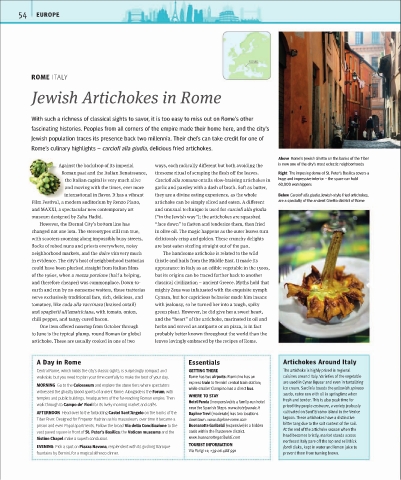
                                                                                                    Above  Rome’s Jewish Ghetto on the banks of the Tiber
                      Against the backdrop of its imperial   ways, each radically different but both avoiding the   is now one of the city’s most eclectic neighborhoods
                       Roman past and the Italian Renaissance,   tiresome ritual of scraping the flesh off the leaves.   Right  The imposing dome of St. Peter’s Basilica covers a
                        the Italian capital is very much alive   Carciofi alla romana entails slow-braising artichokes in   huge and impressive interior – the space can hold
                                                                                                    60,000 worshippers
                        and moving with the times, ever more   garlic and parsley with a dash of broth. Soft as butter,
                        international in flavor. It has a vibrant   they are a divine eating experience, as the whole   Below  Carciofi alla giudia, Jewish-style fried artichokes,
            Film Festival, a modern auditorium by Renzo Piano,   artichoke can be simply sliced and eaten. A different   are a specialty of the ancient Ghetto district of Rome
            and MAXXI, a spectacular new contemporary art   and unusual technique is used for carciofi alla giudia
            museum designed by Zaha Hadid.              (“in the Jewish way”); the artichokes are squashed
               However, the Eternal City’s bottom line has   “face down” to flatten and tenderize them, then fried
            changed not one iota. The stereotypes still run true,   in olive oil. The magic happens as the outer leaves turn
            with scooters zooming along impossibly busy streets,   deliciously crisp and golden. These crunchy delights
            flocks of robed nuns and priests everywhere, noisy   are best eaten sizzling straight out of the pan.
            neighborhood markets, and the dolce vita very much   The handsome artichoke is related to the wild
            in evidence. The city’s host of neighborhood trattorias   thistle and hails from the Middle East. It made its
            could have been plucked straight from Italian films    appearance in Italy as an edible vegetable in the 1500s,
            of the 1960s, when a mezza porzione (half a helping,   but its origins can be traced farther back to another
            and therefore cheaper) was commonplace. Down-to-  classical civilization – ancient Greece. Myths hold that
            earth and run by no-nonsense waiters, these trattorias   mighty Zeus was infatuated with the exquisite nymph
            serve exclusively traditional fare, rich, delicious, and   Cynara, but her capricious behavior made him insane
            tomatoey, like coda alla vaccinara (braised oxtail)   with jealousy, so he turned her into a tough, spiky
            and spaghetti all’amatriciana, with tomato, onion,   green plant. However, he did give her a sweet heart,
            chili pepper, and tangy cured bacon.        and the “heart” of the artichoke, marinated in oil and
               One item offered nonstop from October through    herbs and served as antipasto or on pizza, is in fact
            to June is the typical plump, round Roman (or globe)   probably better known throughout the world than the
            artichoke. These are usually cooked in one of two   leaves lovingly embraced by the recipes of Rome.


              A Day in Rome                                         Essentials                        Artichokes Around Italy
              Central Rome, which holds the city’s classic sights, is surprisingly compact and   GETTING THERE  The artichoke is highly prized in regional
              walkable, but you need to plan your time carefully to make the best of your day.   Rome has two airports: Fiumicino has an   cuisines around Italy. Varieties of the vegetable
                                                                    express train to Termini central train station;   are used in Cynar liqueur and even in tantalizing
              MORNING  Go to the Colosseum and explore the stone tiers where spectators
                                                                    while smaller Ciampino has a direct bus.   ice cream. Sardinia boasts the yellowish spinoso
              witnessed the ghastly blood sports of ancient Rome. Alongside is the Forum, with
                                                                    WHERE TO STAY                     sardo, eaten raw with oil in springtime when
              temples and public buildings, headquarters of the far-reaching Roman empire. Then       fresh and tender. This is also peak time for
                                                                    Hotel Panda (inexpensive) is a family-run hotel
              walk through to Campo de’ Fiori for its lively morning market and cafés.                prized tiny purple castraure, a variety jealously
                                                                    near the Spanish Steps. www.hotelpanda.it
              AFTERNOON  Head over to the forbidding Castel Sant’Angelo on the banks of the   Daphne Trevi (moderate) has two locations   cultivated on Sant’Erasmo island in the Venice
              Tiber River. Designed for Emperor Hadrian as his mausoleum, over time it became a   downtown. www.daphne-rome.com   lagoon. These artichokes have a distinctive
                                                                                                      bitter tang due to the salt content of the soil.
              prison and even Papal apartments. Follow the broad Via della Conciliazione to the   Buonanotte Garibaldi (expensive) is a hidden
                                                                                                      At the end of the artichoke season when the
              vast paved square in front of St. Peter’s Basilica; the Vatican museums and the   oasis within the Trastevere district.     head becomes bristly, market stands across
              Sistine Chapel make a superb conclusion.              www.buonanottegaribaldi.com
                                                                                                      northeast Italy pare off the top and sell thick
                                                                    TOURIST INFORMATION
              EVENING  Pick a spot on Piazza Navona, resplendent with its gushing Baroque             fondi disks, kept in water and lemon juice to
                                                                    Via Parigi 11; +39 06 488 991
              fountains by Bernini, for a magical alfresco dinner.                                    prevent them from turning brown.

