


Page 79 - DK Eyewitness Travel - Guides Ultimate Food Journeys
P. 79
ULM GERMANY 77
The Best Places to
Eat Spätzle
ULM Zunfthaus der Schiffleute
moderate
Once the local guild headquarters for fishermen,
this 15th-century half-timbered house is home
ULM GERMANY
to one of Ulm’s oldest restaurants. Inside, stone
floors with timeless, heavy wooden furniture
Swabian Noodles in Ulm set the perfect scene for traditional Swabian
foods, many of which involve outstanding
homemade Spätzle. Virtually the whole range of
possibilities are here; among them the standard
Most visitors to the pretty city of Ulm are drawn there to see the world’s tallest church spire, Käsespätzle, in its rich cheese sauce, and the
fairly common Linsen (lentils) mit Spätzle and
a staggering piece of Gothic architecture that demonstrates the city’s prosperity in medieval
Krautspätzle. More unusual meal options include
times. But this city – the birthplace of Albert Einstein – is full of surprises, not least the fine the Zunfthaustöpfle, with its creamy herb-heavy
mushroom sauce; and the robust Ulmer Pfännle,
cuisine of the Swabian Alp region and its Italianate little egg noodles known as Spätzle.
in which pork kebabs are smothered in fiery
pepper sauce. Often the most interesting
On the banks of the Danube The legend of the Ulmer Spätze (sparrow of Ulm) was choices are on the restaurant’s seasonal menu,
River sits Ulm, a sleepy old city born. Interestingly, the city’s best-loved dish, Spätzle, where delicious ingredients such as asparagus,
chanterelle mushrooms, and venison are served
that was first mentioned as a means “little sparrow,” although no one is quite sure
with Spätzle. A good selection of local beers is
royal domain in 854 and became why; it may refer to the legend or to the Spätzle’s original
on hand to provide the perfect accompaniment
rich in the Middle Ages through the linen hand-pressed shapes, evident in medieval drawings.
to this rustic fare. But be sure not to overindulge
trade. Its magnificent church dates back to 1377, though Spätzle are served at most of Ulm’s restaurants and on the main courses, as the vanilla ice cream
its ambitious spire wasn’t completed for another 500 at all of its many, boisterous festivals. Shaped like tiny with hot figs is well worth leaving space for.
years. On clear days even the Alps are visible from the dumplings or thin ragged fingers of pasta, Spätzle are Fischergasse 31, Ulm; open 11 AM–midnight
Mon–Sat; www.zunfthaus-ulm.de
top, making it well worth the long climb. The streets made from white wheat flour, egg, and milk dough, to
leading downhill from the minster to the Danube are which minced pork liver is sometimes added to make
Also in Ulm
scattered with fascinating buildings, from the attractive Leberspätzle. This dough is then either finely chopped,
jumble of half-timbered 15th-century houses in the forced though holes in a strainer, or grated into boiling If you’d rather have your Spätzle served with
a gourmet twist, try charming Zur Forelle
Fishermen’s Quarter to the Rathaus (town hall) with its salted water where it is cooked until it surfaces.
(www.zurforelle.com; expensive), which is also
historic frescoes. The Eagle’s Bastion, a nondescript As a standalone dish, Spätzle most commonly
based in a 15th-century Fishermen’s Quarter
17th-century building by the river, is worthy of a visit in appear as Käsespätzle (in a cheese sauce) or as
house. Its Gaisburger Marsch (Swabian beef
memory of the “tailor of Ulm,” who attempted the first Krautspätzle, which includes sauerkraut, onion, butter, stew) is particularly wonderful.
recorded (unsuccessful) flight from here in 1811. marjoram, and caraway. Spätzle also make an
Also in Germany
The city’s symbol is the sparrow. The legendary important appearance in the regional beef stew
tale relates that while building the church, workmen Gaisburger Marsch, along with chopped potatoes and Elsewhere in Swabia, in the venerable university
town of Thübingen, the Hotel am Schloss
were unable to get one of the huge wooden beams butter-fried onions, but most often they simply take the
(www.hotelamschloss.de; moderate) is largely
through the city gates, until they were inspired by the place of potatoes or dumplings in traditional German
famous for its Maultaschen (Swabian ravioli)
sight of a sparrow carrying a twig vertically in its beak. meat dishes such as sauerbraten (see pp92–3).
and fine views of the city, but it always serves
great Spätzle too and isn’t afraid to experiment
with dishes such as venison pot roast with
Ulm Bread Museum hazelnut Spätzle. While it’s easy to find good
Bread had religious importance in Germany for Spätzle in Swabia, it’s much harder elsewhere in
many centuries as an offering in pagan rites. This Germany, particularly in the north, which makes
explains the many shapes still available today: Berlin’s s’Brätle (+49 30 8862 7138; moderate)
round flat loaves once represented the sun, all the more valuable. Its range of southern
while braided loaves symbolized shorn hair. A German specialties include superb Spätzle.
tradition also developed of shaping bread into
nature’s creations, such as horses, birds, deer, Around the World
fish, or sheaves of wheat for special occasions. With many Swabians emigrating to North
Ulm’s Museum der Brotkultur (bread museum) America, it’s also possible to find good Spätzle
confirms bread’s historical importance with its
there too. In Alameda, California, the
staggering 25,000 related objects and books. Speisekammer (www.speisekammer.com;
Most Ulm bakeries offer a wonderful range of
moderate) provides San Francisco’s Bay Area
breads to admire and buy, spanning from coarse,
dark, and slightly sweet rye pumpernickel to with a Käsespätzle to be proud of. On the east
multigrain loaves sprinkled with poppy or coast, Cafe Steinhof (www.cafesteinhof.
sunflower seeds. Many end up in a simple com; inexpensive) does a first-rate job of the
evening meal; the German word for dinner, same dish, even though it classifies itself as
Abendbrot, literally means “evening bread.” an Austrian restaurant.
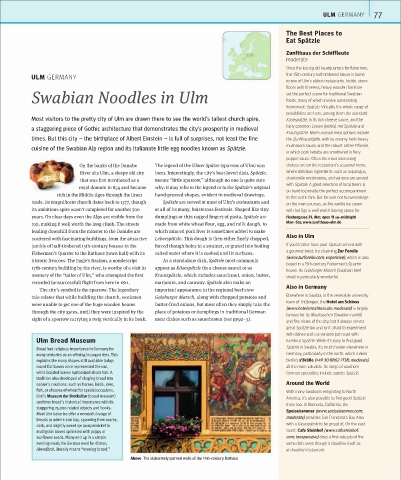
Above The elaborately painted walls of the 14th-century Rathaus

