


Page 142 - (DK Eyewitness) Travel Guide - USA
P. 142
140 NE W ENGLAND
1 Beacon Hill
The south slope of Beacon Hill was, from the 1790s to the
1870s, Boston’s most sought-after neighborhood, until its
wealthy elite decamped to the more exclusive Back Bay.
Many of the district’s houses were designed by the influential
architect Charles Bulfinch (1763–1844) and his disciples, and
the south slope evolved as a textbook example of Federal
architecture. The finest houses are either on Boston Common Beacon Street
or perched on top of the hill, offering fine views. Though The fine Federal-style mansions
the earlier houses were set well back from the street, the here, some with ornate reliefs,
economic depression of 1807–12 overlook the beautiful green
expanse of Boston Common.
resulted in row houses being built
right out to the street.
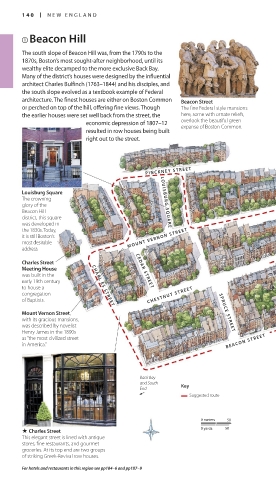
P I N C K N E Y S T R E E T
Louisburg Square
The crowning
glory of the LO U I S B U R G S Q UA R E
Beacon Hill
district, this square
was developed in
the 1830s. Today,
it is still Boston’s M O U N T V E R N O N S T R E E T
most desirable
address.
Charles Street
Meeting House C E D A R S T R E E T
was built in the
early 19th century
to house a C H A R L E S S T R E E T
congregation C H E S T N U T S T R E E T
of Baptists.
Mount Vernon Street, S P R U C E S T R E E T
with its gracious mansions,
was described by novelist
Henry James in the 1890s
as “the most civilized street B E A CO N S T R E E T
in America.”
Back Bay
and South
End Key
Suggested route
0 meters 50
0 yards 50
. Charles Street
This elegant street is lined with antique
stores, fine restaurants, and gourmet
groceries. At its top end are two groups
of striking Greek-Revival row houses.
For hotels and restaurants in this region see pp184–6 and pp187–9
140-141_EW_USA.indd 140 11/2/16 2:44 PM
Eyewitness Travel LAYERS PRINTED:
Catalogue template “UK” LAYER
(Source v2.6)
Date 12th July 2013
Size 125mm x 217mm

