


Page 199 - (DK Eyewitness) Travel Guide - USA
P. 199
INTRODUCING W ASHINGT ON , DC & THE C APIT AL REGION 197
This independent federal territory, termed the Congress’s rule. In 1971 residents were
District of Columbia (DC) was merged with permitted to elect a non-voting delegate
the city of Washington in 1878. When the to Congress and later, in 1973, the Home
government moved to Washington in 1800, Rule Act allowed the people to vote for
the US Capitol and the president’s home both mayor and the city council.
(later renamed the “White House”) were still
under construction. Both were burned People & Culture
by the British during the War of 1812. Washington and the surrounding area reflect
Nothing has been more divisive in the less stereotypical aspects of contemporary US.
region’s history than the issue of slavery. Many Its residents range from “blue-bloods” with
residents were slaveholders; others roots reaching back to before the
became ardent abolitionists. As Mayflower landed at Plymouth Rock,
racial tensions escalated, war to recent immigrants and descend-
between the North and the South ants of African-American slaves. This
became inevitable. Over the course diversity is often surprising. Some of
of the four-year Civil War (1861–65), the most patrician communities are
many significant battles, including in northern Virginia’s anglophile “Hunt
General Robert E. Lee’s surrender at Country” and among Anna polis’
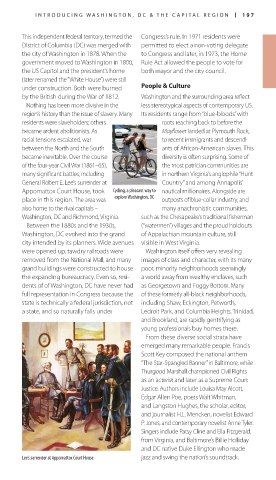
Appo mattox Court House, took Cycling, a pleasant way to nautical millionaires. Alongside are
place in this region. The area was explore Washington, DC outposts of blue-collar industry, and
also home to the rival capitals – many anachronistic communities,
Washington, DC and Richmond, Virginia. such as the Chesapeake’s traditional fisherman
Between the 1880s and the 1930s, (“watermen”) villages and the proud holdouts
Washington, DC evolved into the grand of Appalachian mountain culture, still
city intended by its planners. Wide avenues visible in West Virginia.
were opened up, tawdry railroads were Washington itself offers very revealing
removed from the National Mall, and many images of class and character, with its many
grand buildings were constructed to house poor, minority neighborhoods seemingly
the expanding bureaucracy. Even so, resi- a world away from wealthy enclaves, such
dents of of Washington, DC have never had as Georgetown and Foggy Bottom. Many
full representation in Congress because the of these formerly all-black neighborhoods,
state is technically a federal jurisdiction, not including Shaw, Eckington, Petworth,
a state, and so naturally falls under Ledroit Park, and Columbia Heights, Trinidad,
and Brookland, are rapidly gentrifying as
young professionals buy homes there.
From these diverse social strata have
emerged many remarkable people. Francis
Scott Key composed the national anthem
“The Star-Spangled Banner” in Baltimore, while
Thurgood Marshall championed Civil Rights
as an activist and later as a Supreme Court
Justice. Authors include Louisa May Alcott,
Edgar Allen Poe, poets Walt Whitman,
and Langston Hughes, the scholar, editor,
and journalist H.L. Mencken, novelist Edward
P. Jones, and contemporary novelist Anne Tyler.
Singers include Patsy Cline and Ella Fitzgerald,
from Virginia, and Baltimore’s Billie Holliday
and DC native Duke Ellington who made
Lee’s surrender at Appomattox Court House jazz and swing the nation’s soundtrack.
194-197_EW_USA.indd 197 11/2/16 2:44 PM

