


Page 266 - (DK Eyewitness) Travel Guide - USA
P. 266
264 THE SOUTHEAST
Tennessee
Tennessee is made up of three distinct regions. Memphis
anchors the western lowlands along the Mississippi River;
Nashville, the state capital, heads the central plateau; and
the east is dominated by the Appalachian Mountains,
with Knoxville as its urban base. With the Cumberland
and Tennessee Rivers feeding into the Ohio, then into the
Mississippi, the state was well positioned to prosper from
the steamboat trade, and later, the railroads. During the
Civil War, Chattanooga was the scene of battles, even as
Memphis and Nashville were occupied by Union forces.
Today, Tennessee is known for its tremendous contribution
to American roots music, from bluegrass, country, gospel,
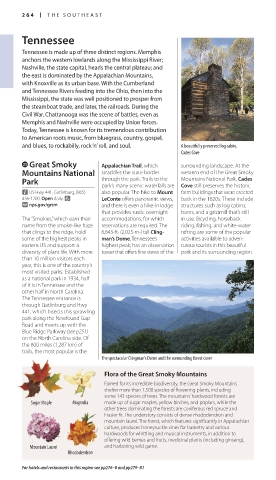
and blues, to rockabilly, rock ‘n’ roll, and soul. A beautifully preserved log cabin,
Cades Cove
d Great Smoky Appalachian Trail, which surrounding landscape. At the
Mountains National straddles the state border western end of the Great Smoky
Park through the park. Trails to the Mountains National Park, Cades
park’s many scenic waterfalls are Cove still preserves the historic
n US Hwy 441, Gatlinburg, (865) also popular. The hike to Mount farm buildings that were erected
436-1200. Open daily. 7 LeConte offers panoramic views, back in the 1820s. These include
∑ nps.gov/grsm and there is even a hike-in lodge structures such as log cabins,
that provides rustic overnight barns, and a gristmill that’s still
The “Smokies,” which earn their accommodations, for which in use. Bicycling, horse back
name from the smoke-like haze reservations are required. The riding, fishing, and white -water
that clings to the ridge, hold 6,643-ft- (2,025-m-) tall Cling rafting are some of the popular
some of the highest peaks in man’s Dome, Tennessee’s activities available to adven-
eastern US and support a highest peak, has an obser vation turous tourists in this beau tiful
diversity of plant life. With more tower that offers fine views of the park and its surrounding region.
than 10 million visitors each
year, this is one of the country’s
most visited parks. Established
as a national park in 1934, half
of it is in Tennessee and the
other half in North Carolina.
The Tennessee entrance is
through Gatlinburg and Hwy
441, which bisects this sprawling
park along the Newfound Gap
Road and meets up with the
Blue Ridge Parkway (see p251)
on the North Carolina side. Of
the 800 miles (1,287 km) of
trails, the most popular is the
The spectacular Clingman’s Dome and the surrounding forest cover
Flora of the Great Smoky Mountains
Famed for its incredible biodiversity, the Great Smoky Mountains
shelter more than 1,500 species of flowering plants, including
some 143 species of trees. The mountains’ hardwood forests are
Sugar Maple Magnolia made up of sugar maples, yellow birches, and poplars, while the
other trees dominating the forests are coniferous red spruce and
Frasier fir. The understory consists of dense rhododendron and
mountain laurel. The forest, which features significantly in Appalachian
culture, produces honeysuckle vines for basketry and various
hardwoods for whittling and musical instruments, in addition to
offering wild berries and fruits, medicinal plants (including ginseng),
Mountain Laurel and harboring wild game.
Rhododendron
For hotels and restaurants in this region see pp276–8 and pp279–81
264-265_EW_USA.indd 264 11/2/16 2:45 PM
Eyewitness Travel LAYERS PRINTED:
Catalogue template “UK” LAYER
(Source v2.6)
Date 12th July 2013
Size 125mm x 217mm

