


Page 49 - (DK Eyewitness) Travel Guide - USA
P. 49
NA TIONAL P ARKS 47
DIRECTORY
Bureau of Land
Management
Tel (202) 208-3516.
∑ blm.gov
National Park Camp ground
Reservations
Tel (877) 444-6777.
∑ recreation.gov
National Parks Pass
∑ nps.gov/findapark/
passes.htm
National Park Service
∑ nps.gov ∑ ohranger.com
US Forest Service
Visitors overlooking Thunder Hole, Acadia National Park, Maine Tel (800) 832-1355.
∑ fs.fed.us
any park entrance, or in privil eges as the Senior Pass,
advance via the Internet (www. is issued free to US citizens or
store.usgs.gov/pass). US citizens permanent residents with Most parks have campsites for
or permanent residents over permanent disabilities. both tents and RVs but these
the age of 62 are eligible for the Documentation of disability are often “unserviced,” with no
Senior Pass (for a one-time $10 is required. RV hookups for electricity, water,
fee), a lifetime pass to national or sewage. Campsites usually
parks, monuments, historic sites, cost $10–50 a night. The US
recreation areas, and wildlife Types of Accommodation Forest Service and Bureau of
refuges. It admits the pass Visitor facilities vary from Land Management campsites
holder and accompanying park to park. Some provide are less expensive and more
passengers in a private very basic amenities, while readily available.
vehicle (if there is a per- others, especially the
vehicle fee), or up to popular ones, have
four adults (at sites deluxe hotels close
with per-person fees). by. It is advisable to
It also provides a 50 make reservations for
percent discount on overnight accom modation
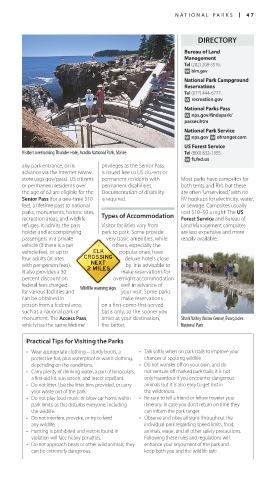
federal fees charged Wildlife warning sign well in advance of
for various facilities and your visit. Some parks
can be obtained in make reservations
person from a federal area, on a first-come-first-served
such as a national park or basis only, so the sooner you
monument. The Access Pass, arrive at your destination, Shark Valley Visitor Center, Everglades
which has the same lifetime the better. National Park
Practical Tips for Visiting the Parks
• Wear appropriate clothing – sturdy boots, a • Talk softly when on park trails to improve your
protective hat, plus waterproof or warm clothing, chances of spotting wildlife.
depending on the conditions. • Do not wander off on your own, and do
• Carry plenty of drinking water, a pair of binoculars, not venture off marked park trails; it is not
a first-aid kit, sun screen, and insect repellant. only hazardous if you encounter dangerous
• Do not litter. Use the litter bins provided, or carry animals but it is also easy to get lost in
your waste out of the park. the wilderness.
• Do not play loud music or blow car horns within • Be sure to tell a friend or fellow traveler your
park limits, as this disturbs everyone, including itinerary; in case you don’t return on time they
the wildlife. can inform the park ranger.
• Do not interfere, provoke, or try to feed • Observe and obey all signs throughout the
any wildlife. individual park regarding speed limits, food,
• Hunting is prohibited and visitors found in animals, water, and all other safety precautions.
violation will face heavy penalties. Following these rules and regulations will
• Do not approach bears or other wild animals; they enhance your enjoyment of the park and
can be extremely dangerous. keep both you and the wildlife safe.
046-047_EW_USA.indd 47 11/2/16 2:43 PM

