


Page 538 - (DK Eyewitness) Travel Guide - USA
P. 538
536 THE SOUTHWEST
m Canyon de Chelly National Monument
The awesome thousand-foot cliffs of the Canyon
de Chelly boast of a long and eventful history
of human habitation. Archaeologists have found
evidence of four periods of Native American culture,
starting with the Basketmaker people around AD
300, followed by the Ancestral Puebloans, who
created the cliff dwellings in the 12th century.
They were succeeded by the Hopi, who lived here
seasonally for around 300 years, taking advantage
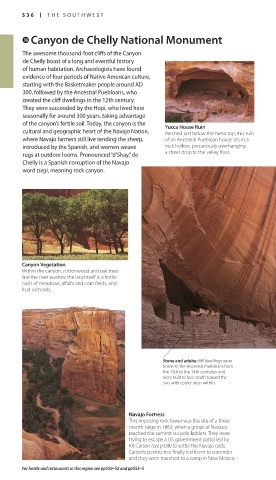
of the canyon’s fertile soil. Today, the canyon is the Yucca House Ruin
cultural and geographic heart of the Navajo Nation, Perched just below the mesa top, this ruin
where Navajo farmers still live tending the sheep, of an Ancestral Puebloan house sits in a
introduced by the Spanish, and women weave rock hollow, precariously overhanging
rugs at outdoor looms. Pronounced “d’Shay,” de a sheer drop to the valley floor.
Chelly is a Spanish corruption of the Navajo
word tsegi, meaning rock canyon.
Canyon Vegetation
Within the canyon, cottonwood and oak trees
line the river washes; the land itself is a fertile
oasis of meadows, alfalfa and corn fields, and
fruit orchards.
Stone and adobe cliff dwellings were
home to the Ancestral Puebloans from
the 12th to the 14th centuries and
were built to face south toward the
sun, with cooler areas within.
Navajo Fortress
This imposing rock tower was the site of a three-
month siege in 1863, when a group of Navajos
reached the summit via pole ladders. They were
trying to escape a US government patrol led by
Kit Carson (see p538) to settle the Navajo raids.
Carson’s persistence finally led them to surrender
and they were marched to a camp in New Mexico.
For hotels and restaurants in this region see pp550–52 and pp553–5
536-537_EW_USA.indd 536 11/2/16 2:47 PM
Eyewitness Travel LAYERS PRINTED:
Feature template “UK” LAYER
(SourceReport v1.3)
Date 18th October 2012
Size 125mm x 217mm

