


Page 674 - (DK Eyewitness) Travel Guide - USA
P. 674
672 C ALIFORNIA
q Death Valley National Park heat-resistant glass, borax is
commonly used today as an
The Native Americans called the valley Tomesha, “the land ingredient in detergents. The
where the ground is on fire,” an apt name for Death Valley, Borax Museum has exhibits
which has the highest mean temperature on earth – the of mining tools and transport
highest ever recorded was 134° F (57° C) in the shade in 1913. machinery used at the
19th-century refinery.
This is a land of wrenching extremes, a sunken trough in the Salt Creek, lying near the
earth’s crust that reaches the lowest point in the western Borax Museum, supports
hemisphere. The park stretches 140 miles (225 km) and is the hardy pupfish. Endemic
guarded on two sides by some of the highest mountains to Death Valley, the pupfish
on the continent. Its unique landscape includes delicate can live in water almost four
times as salty as the sea and
rock formations, polished canyons, and burning salt flats. can with stand temperatures
Although always inhospitable, it is one of the most of up to 111° F (44° C). The fish
popular tourist destinations in California. attract other wildlife, including
great blue herons. Walkways
allow visitors to explore this
Today, the same springs make unique site.
Furnace Creek a desert oasis Some of the Valley’s most
shaded by date palms. There breathtaking natural features lie
are a variety of restaurants and south of Furnace Creek. About 3
motels, and the Death Valley miles (5 km) south, on Hwy 178,
Museum and Visitor Center a short hike leads into Golden
has exhibits and slide shows Canyon. The mustard-colored
explaining the area’s natural and walls after which the canyon
human history. In winter, ranger was named, are best seen in
programs and guided walks are the afternoon sun. Native
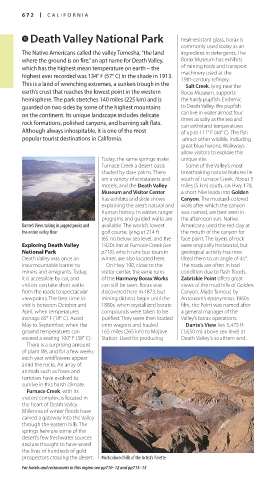
Dante’s View, taking in jagged peaks and available. The world’s lowest Americans used the red clay at
the entire valley floor golf course, lying at 214 ft the mouth of the canyon for
(65 m) below sea level, and the face paint. The layers of rock
Exploring Death Valley 1920s Inn at Furnace Creek (see were originally horizontal, but
National Park p710), which runs bus tours in geological activity has now
Death Valley was once an winter, are also located here. tilted them to an angle of 45°.
insurmountable barrier to On Hwy 190, close to the The roads are often in bad
miners and emigrants. Today, visitor center, the eerie ruins condition due to flash floods.
it is accessible by car, and of the Harmony Borax Works Zabriskie Point offers great
visitors can take short walks can still be seen. Borax was views of the mud hills of Golden
from the roads to spectacular discovered here in 1873, but Canyon. Made famous by
viewpoints. The best time to mining did not begin until the Antonioni’s eponymous 1960s
visit is between October and 1880s, when crystallized borate film, the Point was named after
April, when temperatures compounds were taken to be a general manager of the
average 65° F (18° C). Avoid purified. They were then loaded Valley’s borax operations.
May to September, when the onto wagons and hauled Dante’s View lies 5,475 ft
ground temperatures can 165 miles (265 km) to Mojave (1,650 m) above sea level at
exceed a searing 100° F (38° C). Station. Used for producing Death Valley’s southern end.
There is a surprising amount
of plant life, and for a few weeks
each year wildflowers appear
amid the rocks. An array of
animals such as foxes and
tortoises have evolved to
survive in this harsh climate.
Furnace Creek, with its
visitors’ complex, is located in
the heart of Death Valley.
Millennia of winter floods have
carved a gateway into the Valley
through the eastern hills. The
springs here are some of the
desert’s few freshwater sources
and are thought to have saved
the lives of hundreds of gold
prospectors crossing the desert. Multicolored hills of the Artist’s Palette
For hotels and restaurants in this region see pp710–12 and pp713–15
672-673_EW_USA.indd 672 11/2/16 2:49 PM
Eyewitness Travel LAYERS PRINTED:
Catalogue template “UK” LAYER
(Source v2.7)
Date 1st October 2013
Size 125mm x 217mm

