


Page 11 - Easy Japanese - Learn to Speak Japanese Quickly! (TUTTLE)
P. 11
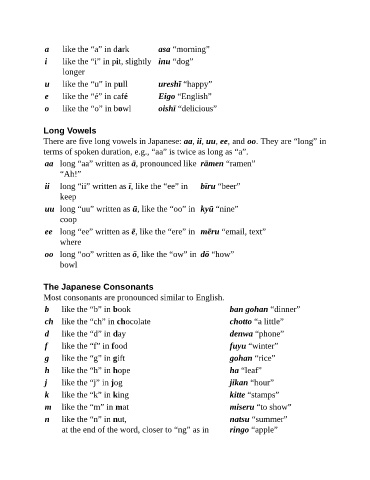
a     like the “a” in dark           asa “morning”
                i     like the “i” in pit, slightly inu “dog”
                      longer

                u     like the “u” in pull           ureshī “happy”
                e     like the “é” in café           Eigo “English”

                o     like the “o” in bowl           oishī “delicious”


               Long Vowels
               There are five long vowels in Japanese: aa, ii, uu, ee, and oo. They are “long” in

               terms of spoken duration, e.g., “aa” is twice as long as “a”.
                aa long “aa” written as ā, pronounced like rāmen “ramen”
                     “Ah!”

                ii   long “ii” written as ī, like the “ee” in      bīru “beer”
                     keep
                uu long “uu” written as ū, like the “oo” in kyū “nine”

                     coop
                ee long “ee” written as ē, like the “ere” in mēru “email, text”
                     where

                oo long “oo” written as ō, like the “ow” in dō “how”
                     bowl


               The Japanese Consonants

               Most consonants are pronounced similar to English.
                b    like the “b” in book                                    ban gohan “dinner”

                ch like the “ch” in chocolate                                chotto “a little”
                d    like the “d” in day                                     denwa “phone”

                f    like the “f” in food                                    fuyu “winter”
                g    like the “g” in gift                                    gohan “rice”

                h    like the “h” in hope                                    ha “leaf”
                j    like the “j” in jog                                     jikan “hour”

                k    like the “k” in king                                    kitte “stamps”
                m    like the “m” in mat                                     miseru “to show”

                n    like the “n” in nut,                                    natsu “summer”
                     at the end of the word, closer to “ng” as in            ringo “apple”

