


Page 12 - Easy Japanese - Learn to Speak Japanese Quickly! (TUTTLE)
P. 12
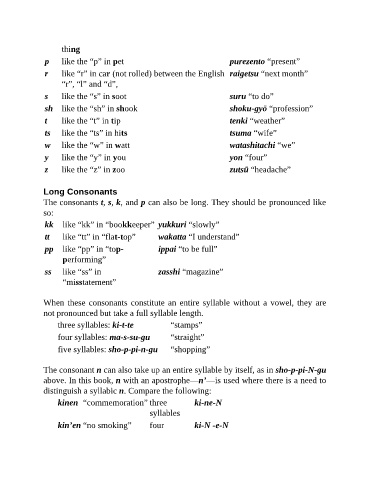
thing
                p    like the “p” in pet                                     purezento “present”
                r    like “r” in car (not rolled) between the English raigetsu “next month”

                     “r”, “l” and “d”,
                s    like the “s” in soot                                    suru “to do”

                sh   like the “sh” in shook                                  shoku-gyō “profession”
                t    like the “t” in tip                                     tenki “weather”

                ts   like the “ts” in hits                                   tsuma “wife”
                w    like the “w” in watt                                    watashitachi “we”

                y    like the “y” in you                                     yon “four”
                z    like the “z” in zoo                                     zutsū “headache”


               Long Consonants
               The consonants t, s, k, and p can also be long. They should be pronounced like
               so:

                kk    like “kk” in “bookkeeper” yukkuri “slowly”
                tt    like “tt” in “flat-top”        wakatta “I understand”

                pp    like “pp” in “top-             ippai “to be full”
                      performing”
                ss    like “ss” in                   zasshi “magazine”

                      “misstatement”


               When these consonants constitute an entire syllable without a vowel, they are
               not pronounced but take a full syllable length.
                    three syllables: ki-t-te             “stamps”

                    four syllables: ma-s-su-gu           “straight”
                    five syllables: sho-p-pi-n-gu        “shopping”


               The consonant n can also take up an entire syllable by itself, as in sho-p-pi-N-gu
               above. In this book, n with an apostrophe—n’—is used where there is a need to
               distinguish a syllabic n. Compare the following:
                    kinen “commemoration” three                  ki-ne-N
                                                   syllables

                    kin’en “no smoking”            four          ki-N -e-N

