


Page 149 - Easy Japanese - Learn to Speak Japanese Quickly! (TUTTLE)
P. 149
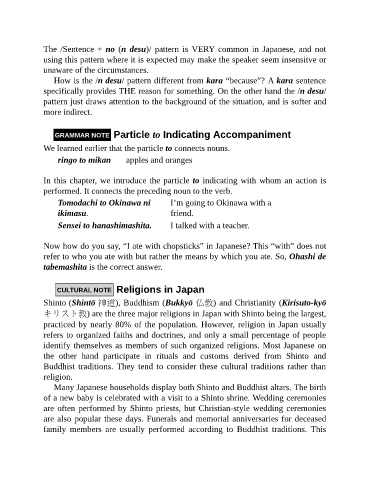
The /Sentence + no  (n  desu)/  pattern is  VERY common in Japanese, and not
               using this pattern where it is expected may make the speaker seem insensitve or
               unaware of the circumstances.
                   How is the /n desu/ pattern different from kara “because”? A kara sentence
               specifically provides THE reason for something. On the other hand the /n desu/
               pattern just draws attention to the background of the situation, and is softer and
               more indirect.


                   GRAMMAR NOTE Particle to Indicating Accompaniment

               We learned earlier that the particle to connects nouns.
                    ringo to mikan         apples and oranges


               In this chapter, we introduce the particle to indicating with whom an action is

               performed. It connects the preceding noun to the verb.
                    Tomodachi to Okinawa ni              I’m going to Okinawa with a
                    ikimasu.                             friend.

                    Sensei to hanashimashita.            I talked with a teacher.


               Now how do you say, “I ate with chopsticks” in Japanese? This “with” does not
               refer to who you ate with but rather the means by which you ate. So, Ohashi de
               tabemashita is the correct answer.


                    CULTURAL NOTE  Religions in Japan

               Shinto (Shintō 神道), Buddhism (Bukkyō 仏教) and Christianity (Kirisuto-kyō
               キリスト教) are the three major religions in Japan with Shinto being the largest,
               practiced by nearly 80% of the population. However, religion in Japan usually
               refers to organized faiths and doctrines, and only a small percentage of people

               identify themselves as members of such organized religions. Most Japanese on
               the  other  hand  participate  in  rituals  and  customs  derived  from  Shinto  and
               Buddhist traditions. They tend to consider these cultural traditions rather than
               religion.
                   Many Japanese households display both Shinto and Buddhist altars. The birth
               of a new baby is celebrated with a visit to a Shinto shrine. Wedding ceremonies

               are often performed by Shinto priests, but Christian-style wedding ceremonies
               are also popular these days. Funerals and memorial anniversaries for deceased
               family  members  are  usually  performed  according  to  Buddhist  traditions.  This

