


Page 18 - Easy Japanese - Learn to Speak Japanese Quickly! (TUTTLE)
P. 18
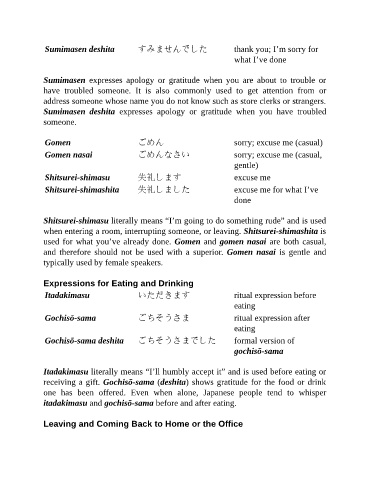
Sumimasen deshita              すみませんでした                       thank you; I’m sorry for
                                                                              what I’ve done


               Sumimasen  expresses  apology  or  gratitude  when  you  are  about  to  trouble  or
               have  troubled  someone.  It  is  also  commonly  used  to  get  attention  from  or
               address someone whose name you do not know such as store clerks or strangers.
               Sumimasen  deshita  expresses  apology  or  gratitude  when  you  have  troubled
               someone.


                Gomen                          ごめん                            sorry; excuse me (casual)
                Gomen nasai                    ごめんなさい                         sorry; excuse me (casual,
                                                                              gentle)

                Shitsurei-shimasu              失礼します                          excuse me
                Shitsurei-shimashita           失礼しました                         excuse me for what I’ve

                                                                              done


               Shitsurei-shimasu literally means “I’m going to do something rude” and is used
               when entering a room, interrupting someone, or leaving. Shitsurei-shimashita is
               used for what you’ve already done. Gomen and gomen nasai are both casual,
               and  therefore  should  not  be  used with a  superior. Gomen nasai  is  gentle  and

               typically used by female speakers.


               Expressions for Eating and Drinking
                Itadakimasu                    いただきます                         ritual expression before
                                                                              eating

                Gochisō-sama                   ごちそうさま                         ritual expression after
                                                                              eating

                Gochisō-sama deshita           ごちそうさまでした                      formal version of
                                                                              gochisō-sama


               Itadakimasu literally means “I’ll humbly accept it” and is used before eating or
               receiving a gift. Gochisō-sama (deshita) shows gratitude for the food or drink
               one  has  been  offered.  Even  when  alone,  Japanese  people  tend  to  whisper
               itadakimasu and gochisō-sama before and after eating.


               Leaving and Coming Back to Home or the Office

