


Page 17 - Easy Japanese - Learn to Speak Japanese Quickly! (TUTTLE)
P. 17
doctors, lawyers or someone else who is a “master” in their field (generally a
               very senior person). You should not use -san to refer to people in these roles.
                   Hai means “that’s right”, “present” (in roll call), or “here you are” (handing
               something over).


               Requesting and Offering

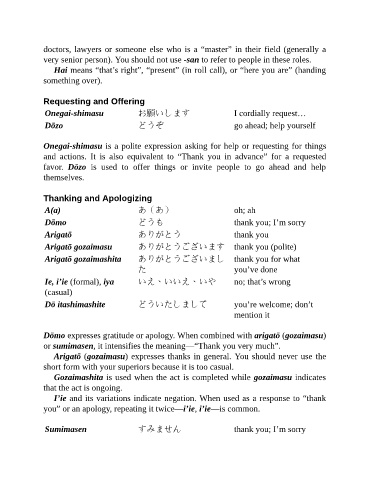
                Onegai-shimasu                 お願いします                         I cordially request…
                Dōzo                           どうぞ                            go ahead; help yourself


               Onegai-shimasu is a polite expression asking for help or requesting for things
               and  actions.  It  is  also  equivalent  to  “Thank  you  in  advance”  for  a  requested
               favor.  Dōzo  is  used  to  offer  things  or  invite  people  to  go  ahead  and  help
               themselves.


               Thanking and Apologizing

                A(a)                           あ(あ)                           oh; ah
                Dōmo                           どうも                            thank you; I’m sorry

                Arigatō                        ありがとう                          thank you
                Arigatō gozaimasu              ありがとうございます                     thank you (polite)

                Arigatō gozaimashita           ありがとうございまし                     thank you for what
                                               た                              you’ve done

                Ie, i’ie (formal), iya         いえ、いいえ、いや                      no; that’s wrong
                (casual)
                Dō itashimashite               どういたしまして                       you’re welcome; don’t
                                                                              mention it


               Dōmo expresses gratitude or apology. When combined with arigatō (gozaimasu)

               or sumimasen, it intensifies the meaning—“Thank you very much”.
                   Arigatō (gozaimasu) expresses thanks in general. You should never use the
               short form with your superiors because it is too casual.
                   Gozaimashita is used when the act is completed while gozaimasu indicates
               that the act is ongoing.

                   I’ie and its variations indicate negation. When used as a response to “thank
               you” or an apology, repeating it twice—i’ie, i’ie—is common.


                Sumimasen                      すみません                          thank you; I’m sorry

