


Page 32 - All About History - Issue 38-16
P. 32
Isabella of Castile’s Spanish Inquisition


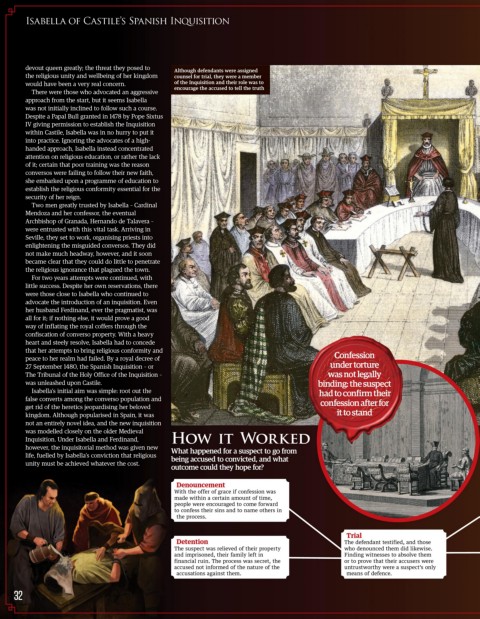
            devout queen greatly; the threat they posed to   Although defendants were assigned
            the religious unity and wellbeing of her kingdom   counsel for trial, they were a member
            would have been a very real concern.     of the Inquisition and their role was to
              There were those who advocated an aggressive   encourage the accused to tell the truth
            approach from the start, but it seems Isabella
            was not initially inclined to follow such a course.
            Despite a Papal Bull granted in 1478 by Pope Sixtus
            IV giving permission to establish the Inquisition
            within Castile, Isabella was in no hurry to put it
            into practice. Ignoring the advocates of a high-
            handed approach, Isabella instead concentrated
            attention on religious education, or rather the lack
            of it; certain that poor training was the reason
            conversos were failing to follow their new faith,
            she embarked upon a programme of education to
            establish the religious conformity essential for the
            security of her reign.
              Two men greatly trusted by Isabella – Cardinal
            Mendoza and her confessor, the eventual
            Archbishop of Granada, Hernando de Talavera –
            were entrusted with this vital task. Arriving in
            Seville, they set to work, organising priests into
            enlightening the misguided conversos. They did
            not make much headway, however, and it soon
            became clear that they could do little to penetrate
            the religious ignorance that plagued the town.
              For two years attempts were continued, with
            little success. Despite her own reservations, there
            were those close to Isabella who continued to
            advocate the introduction of an inquisition. Even
            her husband Ferdinand, ever the pragmatist, was
            all for it; if nothing else, it would prove a good
            way of inflating the royal coffers through the
            confiscation of converso property. With a heavy
            heart and steely resolve, Isabella had to concede
            that her attempts to bring religious conformity and                                 Confession
            peace to her realm had failed. By a royal decree of
            27 September 1480, the Spanish Inquisition – or                                    under torture
            The Tribunal of the Holy Office of the Inquisition –                              was not legally
            was unleashed upon Castile.                                                     binding: the suspect

              Isabella’s initial aim was simple: root out the                               had to con rm their
            false converts among the converso population and                                confession after for
            get rid of the heretics jeopardising her beloved
            kingdom. Although popularised in Spain, it was                                       it to stand
            not an entirely novel idea, and the new inquisition
            was modelled closely on the older Medieval
                                                                           or
                                                                                    e
                                                                                 k
                                                                i
                                                       ow
                                                                      W
                                                                  t
                                                    H
                                                                                      d
            Inquisition. Under Isabella and Ferdinand,   How it Worked
            however, the inquisitorial method was given new   What happened for a suspect to go from
            life, fuelled by Isabella’s conviction that religious   being accused to convicted, and what
            unity must be achieved whatever the cost.   outcome could they hope for?
                                                     Denouncement
                                                     With the offer of grace if confession was
                                                     made within a certain amount of time,
                                                     people were encouraged to come forward
                                                     to confess their sins and to name others in
                                                     the process.
                                                                                                   Trial
                                                     Detention                                     The defendant testi ied, and those
                                                     The suspect was relieved of their property    who denounced them did likewise.
                                                     and imprisoned, their family left in          Finding witnesses to absolve them
                                                      inancial ruin. The process was secret, the   or to prove that their accusers were
                                                     accused not informed of the nature of the     untrustworthy were a suspect’s only
                                                     accusations against them.                     means of defence.
         32


       028-036_AAH_038_Issabella of Castille.indd   32                                                                       13/04/2016   22:37

