


Page 37 - All About History - Issue 38-16
P. 37
Isabella of Castile’s Spanish Inquisition


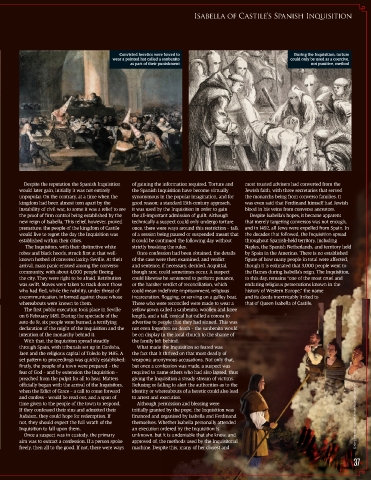
                                               Convicted heretics were forced to                             During the Inquisition, torture
                                             wear a pointed hat called a sanbenito                         could only be used as a coercive,
                                                   as part of their punishment                                     not punitive, method


              Despite the reputation the Spanish Inquisition   of gaining the information required. Torture and   most trusted advisers had converted from the
            would later gain, initially it was not entirely   the Spanish Inquisition have become virtually   Jewish faith, with three secretaries that served
            unpopular. On the contrary, at a time when the   synonymous in the popular imagination, and for   the monarchs being from converso families. It
            kingdom had been almost torn apart by the   good reason: a standard 15th-century approach,   was even said that Ferdinand himself had Jewish
            instability of civil war, to some it was a relief to see   it was used by the Inquisition in order to gain   blood in his veins from converso ancestors.
            the proof of firm control being established by the   the all-important admission of guilt. Although   Despite Isabella’s hopes, it became apparent
            new reign of Isabella. This relief, however, proved   technically a suspect could only undergo torture   that merely targeting conversos was not enough,
            premature: the people of the kingdom of Castile   once, there were ways around this restriction – talk   and in 1492, all Jews were expelled from Spain. In
            would live to regret the day the Inquisition was   of a session being paused or suspended meant that   the decades that followed, the Inquisition spread
            established within their cities.        it could be continued the following day without   throughout Spanish-held territory, including
               The Inquisitors, with their distinctive white   strictly breaking the rules.   Naples, the Spanish Netherlands, and territory held
            robes and black hoods, struck first at that well-  Once confession had been obtained, the details   by Spain in the Americas. There is no established
            known hotbed of converso laxity: Seville. At their   of the case were then examined, and verdict   figure of how many people in total were affected,
            arrival, mass panic ensued among the converso   and sentence, if necessary, decided. Acquittal,   though it is estimated that 3,000 people went to
            community, with about 4,000 people fleeing   though rare, could sometimes occur. A suspect   the flames during Isabella’s reign. The Inquisition,
            the city. They were right to be afraid. Retribution   could likewise be sentenced to perform penance,   to this day, remains “one of the most cruel and
            was swift. Moves were taken to track down those   or the harsher verdict of reconciliation, which   enduring religious persecutions known in the
            who had fled, while the nobility, under threat of   could mean indefinite imprisonment, religious   history of Western Europe,” the name
            excommunication, informed against those whose   incarceration, flogging, or serving on a galley boat.   and its deeds inextricably linked to
            whereabouts were known to them.         Those who were reconciled were made to wear a   that of Queen Isabella of Castile.
              The first public execution took place in Seville   yellow gown called a sanbenito, woollen and knee
            on 6 February 1481. During the spectacle of the   length, and a tall, conical hat called a coroza to
            auto de fe, six people were burned, a terrifying   advertise to people that they had sinned. This was
            declaration of the might of the Inquisition and the   not even forgotten on death – the sanbenito would
            intention of the monarchy behind it.    be on display in the local church to the shame of
              With that, the Inquisition spread steadily   the family left behind.
            through Spain, with tribunals set up in Cordoba,   What made the Inquisition so feared was
            Jaen and the religious capital of Toledo by 1485. A   the fact that it thrived on that most deadly of
            set pattern to proceedings was quickly established:   weapons: anonymous accusations. Not only that,
            firstly, the people of a town were prepared – the   but once a confession was made, a suspect was
            fear of God – and by extension the Inquisition –   required to name others who had also lapsed, thus
            preached from the pulpit for all to hear. Matters   giving the Inquisition a steady stream of victims.
            officially began with the arrival of the Inquisitors,   Refusing or failing to alert the authorities as to the
            when the Edict of Grace – a call to come forward   identity or whereabouts of a heretic could also lead
            and confess – would be read out, and a span of   to arrest and execution.
            time given to the people of the town to respond.   Although permission and blessing were
            If they confessed their sins and admitted their   initially granted by the pope, the Inquisition was
            Judaism, they could hope for redemption. If   financed and organised by Isabella and Ferdinand                        © Alamy, freevectormaps.com, Nicholas Forder, Joe Cummings
            not, they should expect the full wrath of the   themselves. Whether Isabella personally attended
            Inquisition to fall upon them.          an execution ordered by the Inquisition is
              Once a suspect was in custody, the primary   unknown, but it is undeniable that she knew, and
            aim was to extract a confession. If a person spoke   approved of, the methods used by the Inquisitorial
            freely, then all to the good. If not, there were ways   machine. Despite this, many of her closest and

                                                                                                                                  37


       028-036_AAH_038_Issabella of Castille.indd   37                                                                       14/04/2016   00:25

