


Page 7 - Essential Tagalog - Speak Tagalog with Confidence (TUTTLE)
P. 7
Pronunciation guide


                  The national language of the Philippines, Filipino, is based on
                Tagalog, one of the major languages of the country.
                  Learning to speak in Tagalog is not difficult. Anyone with a
                knowledge of English or Spanish pronunciation can easily become
                familiar with the standard pronunciation of Tagalog words.
                Since its adoption in 1987, the new Tagalog alphabet consists of
                28 letters: a, b, c, d, e, f, g, h, i, j, k, l, m, n, ñ, ng, o, p, q, r, s, t, u, v,
                w, x, y, z. (See 1.9 Telephone alphabet for pronunciation of
                the alphabet)
                The original twenty letters of the old alphabet (a, b, k, d, e, g, h, i,
                l, m, n, ng, o, p, r, s, t, u, w, y) form part of the new alphabet.  The
                additional letters (c, f, j, ñ, q, v, x, z) are mainly used in the spell-
                ing of words assimilated from various foreign languages, espe-
                cially English and Spanish.

                The user of this phrase book should not be worried about mak-
                ing errors in communicating with native speakers. You will learn
                so much from the interactions. Practice in proper pronunciation
                is a big help. The imitated pronunciation should be read as if it
                were English (except ñ which comes from Spanish), and bearing
                in mind these main points:

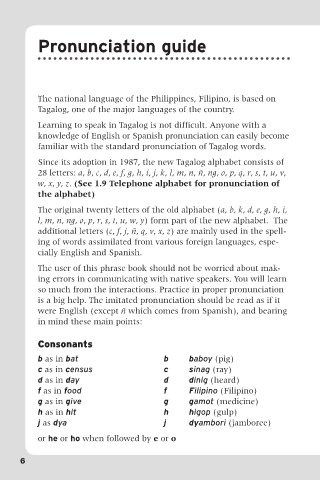
                  Consonants
                b as in bat                  b     baboy (pig)
                c as in census               c      sinag (ray)
                d as in day                  d      dinig (heard)
                f as in food                 f    Filipino (Filipino)
                g as in give                 g    gamot (medicine)
                h as in hit                  h    higop (gulp)
                j as dya                     j    dyambori (jamboree)
                or he or ho when followed by e or o


            6


                                                                      4/25/12   9:24 AM
          Essential Tagalog_Interior.indd   6
          Essential Tagalog_Interior.indd   6                         4/25/12   9:24 AM

