


Page 12 - Essential Tagalog - Speak Tagalog with Confidence (TUTTLE)
P. 12
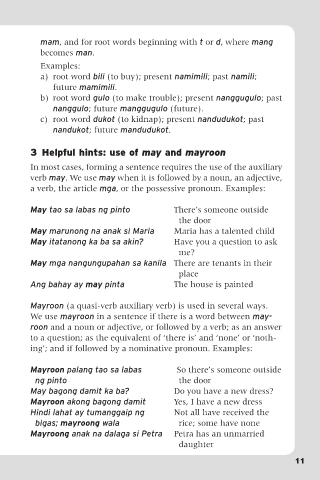
mam, and for root words beginning with t or d, where mang
                 becomes man.
                Examples:
                 a) root word bili (to buy); present namimili; past namili;
                    future mamimili.
                 b) root word gulo (to make trouble); present nanggugulo; past
                    nanggulo; future manggugulo (future).
                 c) root word dukot (to kidnap); present nandudukot; past
                    nandukot; future mandudukot.

               3  Helpful hints: use of may and mayroon
               In most cases, forming a sentence requires the use of the auxiliary
               verb may. We use may when it is followed by a noun, an adjective,
               a verb, the article mga, or the possessive pronoun. Examples:

               May tao sa labas ng pinto       There’s someone outside
                                                 the door
               May marunong na anak si Maria   Maria has a talented child
               May itatanong ka ba sa akin?    Have you a question to ask
                                                 me?
               May mga nangungupahan sa kanila  There are tenants in their
                                                 place
               Ang bahay ay may pinta          The house is painted

               Mayroon (a quasi-verb auxiliary verb) is used in several ways.
               We use mayroon in a sentence if there is a word between may-
               roon and a noun or adjective, or followed by a verb; as an answer
               to a question; as the equivalent of ‘there is’ and ‘none’ or ‘noth-
               ing’; and if followed by a nominative pronoun. Examples:

               Mayroon palang tao sa labas     So there’s someone outside
                 ng pinto                        the door
               May bagong damit ka ba?         Do you have a new dress?
               Mayroon akong bagong damit      Yes, I have a new dress
               Hindi lahat ay tumanggaip ng    Not all have received the
                 bigas; mayroong wala            rice; some have none
               Mayroong anak na dalaga si Petra   Petra has an unmarried
                                                 daughter

                                                                          11


                                                                      4/25/12   9:24 AM
          Essential Tagalog_Interior.indd   11
          Essential Tagalog_Interior.indd   11                        4/25/12   9:24 AM

