


Page 340 - (DK) The Ultimate Visual Dictionary 2nd Ed.
P. 340
RAIL AND ROAD

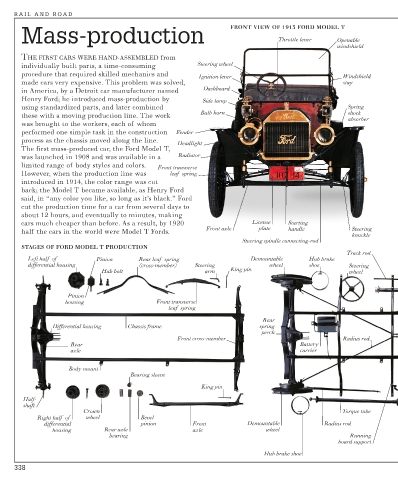
       Mass-production                                           FRONT VIEW OF 1913 FORD MODEL T
                                                                              Throttle lever
                                                                                               Openable
                                                                                               windshield
       THE FIRST CARS WERE HAND-ASSEMBLED from
       individually built parts, a time-consuming       Steering wheel
       procedure that required skilled mechanics and    Ignition lever                          Windshield
       made cars very expensive. This problem was solved,                                       stay
       in America, by a Detroit car manufacturer named   Dashboard
       Henry Ford; he introduced mass-production by      Side lamp
       using standardized parts, and later combined                                               Spring
                                                         Bulb horn                                shock
       these with a moving production line. The work
                                                                                                  absorber
       was brought to the workers, each of whom
       performed one simple task in the construction   Fender
       process as the chassis moved along the line.
                                                  Headlight
       The first mass-produced car, the Ford Model T,
       was launched in 1908 and was available in a   Radiator
       limited range of body styles and colors.   Front transverse
       However, when the production line was    leaf  spring
       introduced in 1914, the color range was cut
       back; the Model T became available, as Henry Ford
       said, in “any color you like, so long as it’s black.” Ford
       cut the production time for a car from several days to
       about 12 hours, and eventually to minutes, making
       cars much cheaper than before. As a result, by 1920             License   Starting
                                                          Front axle     plate   handle            Steering
       half the cars in the world were Model T Fords.
                                                                                                   knuckle
                                                                    Steering spindle connecting-rod
       STAGES OF FORD MODEL T PRODUCTION
                                                                                                 Track rod
         Left half  of      Pinion      Rear leaf  spring              Demountable     Hub brake
         differential housing           (cross-member)  Steering            wheel      shoe       Steering
                             Hub bolt                     arm    King pin                         wheel


                    Pinion
                   housing                  Front transverse
                                                leaf  spring
                                                                          Rear
                Differential housing  Chassis frame                      spring
                                                                          perch
                                                  Front cross-member                            Radius rod
                     Rear                                                           Battery
                     axle                                                           carrier


                    Body mount
                                     Bearing sleeve
                                                         King pin
       Half-
       shaft
                        Crown                                                                   Torque tube
           Right half  of    wheel      Bevel
             differential               pinion         Front          Demountable          Radius rod
                housing       Rear axle                axle                wheel
                               bearing                                                            Running
                                                                                               board support
                                                                          Hub brake shoe

     338

