


Page 344 - (DK) The Ultimate Visual Dictionary 2nd Ed.
P. 344
RAIL AND ROAD
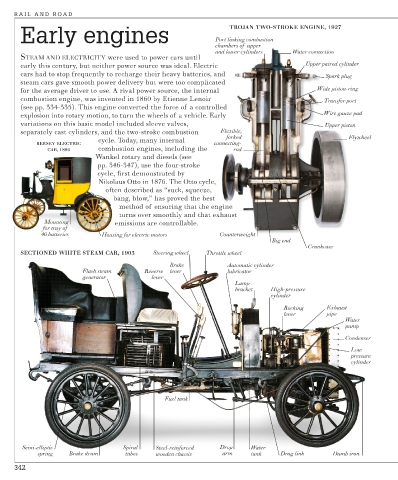
                                                                 TROJAN TWO-STROKE ENGINE, 1927
       Early engines                                         Port linking combustion

                                                             chambers of  upper
                                                             and lower cylinders  Water connection
       STEAM AND ELECTRICITY were used to power cars until
       early this century, but neither power source was ideal. Electric               Upper paired cylinder
       cars had to stop frequently to recharge their heavy batteries, and                  Spark plug
       steam cars gave smooth power delivery but were too complicated
       for the average driver to use. A rival power source, the internal                 Wide piston-ring
       combustion engine, was invented in 1860 by Etienne Lenoir                           Transfer port
       (see pp. 334-335). This engine converted the force of a controlled
                                                                                           Wire gauze pad
       explosion into rotary motion, to turn the wheels of a vehicle. Early
       variations on this basic model included sleeve valves,                              Upper piston
       separately cast cylinders, and the two-stroke combustion   Flexible,
                                                                forked                            Flywheel
                            cycle. Today, many internal
           BERSEY ELECTRIC                                  connecting-
              CAB, 1896     combustion engines, including the     rod
                            Wankel rotary and diesels (see
                            pp. 346-347), use the four-stroke
                            cycle, first demonstrated by
                            Nikolaus Otto in 1876. The Otto cycle,
                              often described as “suck, squeeze,
                                 bang, blow,” has proved the best
                                  method of ensuring that the engine
                                  turns over smoothly and that exhaust
             Mounting            emissions are controllable.
             for tray of
            40 batteries     Housing for electric motors      Counterweight
                                                                             Big end
                                                                                       Crankcase
       SECTIONED WHITE STEAM CAR, 1903      Steering wheel  Throttle wheel
                                                Brake           Automatic cylinder
                        Flash steam      Reverse   lever        lubricator
                        generator          lever
                                                                  Lamp
                                                                  bracket   High-pressure
                                                                            cylinder
                                                                                Rocking     Exhaust
                                                                                lever       pipe
                                                                                                 Water
                                                                                                 pump
                                                                                                 Condenser
                                                                                                  Low-
                                                                                                  pressure
                                                                                                  cylinder


                                               Fuel tank


       Semi-elliptic               Spiral   Steel-reinforced   Drop    Water
           spring   Brake drum      tubes   wooden chassis     arm     tank    Drag link     Dumb iron

     342

