


Page 368 - (DK) The Ultimate Visual Dictionary 2nd Ed.
P. 368
RAIL AND ROAD

       Motorcycle                                        EXTERIOR OF STANDARD TWO-STROKE ENGINE

                                                                      Spark       Fuel tap
                                                                      plug cap
       engines                                                                             Carburetor
                                                                                           mounting
                                                                                               Kick-starter
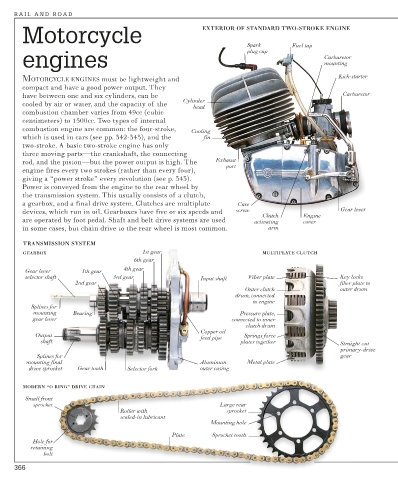
       MOTORCYCLE ENGINES must be lightweight and
       compact and have a good power output. They
       have between one and six cylinders, can be                                               Carburetor
                                                    Cylinder
       cooled by air or water, and the capacity of the
                                                       head
       combustion chamber varies from 49cc (cubic
       centimeters) to 1500cc. Two types of internal
       combustion engine are common: the four-stroke,   Cooling
       which is used in cars (see pp. 342-343), and the   fin
       two-stroke. A basic two-stroke engine has only
       three moving parts—the crankshaft, the connecting
       rod, and the piston—but the power output is high. The   Exhaust
                                                                port
       engine fires every two strokes (rather than every four),
       giving a “power stroke” every revolution (see p. 343).
       Power is conveyed from the engine to the rear wheel by
       the transmission system. This usually consists of a clutch,
       a gearbox, and a final drive system. Clutches are multiplate   Case
       devices, which run in oil. Gearboxes have five or six speeds and   screw                 Gear lever
                                                                          Clutch     Engine
       are operated by foot pedal. Shaft and belt drive systems are used   activating   cover
       in some cases, but chain drive to the rear wheel is most common.     arm

       TRANSMISSION SYSTEM
       GEARBOX                           1st gear                         MULTIPLATE CLUTCH
                                      6th gear
                                   4th gear
        Gear lever      5th gear
        selector shaft          3rd gear                 Input shaft  Fiber plate              Key locks
                      2nd gear                                                                 fiber plate to
                                                                     Outer clutch              outer drum
                                                                  drum, connected
                                                                       to engine
          Splines for
          mounting   Bearing                                        Pressure plate,
          gear lever                                             connected to inner
                                                                     clutch drum
                                                         Copper oil
           Output                                        feed pipe   Springs force
            shaft                                                   plates together             Straight-cut
                                                                                                primary-drive
           Splines for                                                                          gear
        mounting final                                   Aluminum     Metal plate
         drive sprocket  Gear tooth  Selector fork       outer casing

       MODERN “O RING” DRIVE CHAIN
        Small front
          sprocket                                            Large rear
                                  Roller with                   sprocket
                                  sealed-in lubricant
                                                           Mounting hole
                                                 Plate      Sprocket tooth
          Hole for
         retaining
             bolt

     366

