


Page 386 - (DK) The Ultimate Visual Dictionary 2nd Ed.
P. 386
Sails
       PARREL
       BEADS

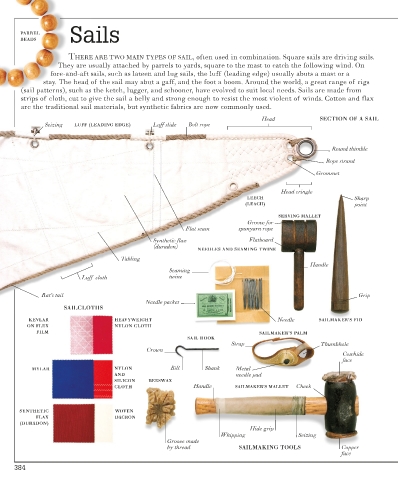
                    THERE ARE TWO MAIN TYPES OF SAIL, often used in combination. Square sails are driving sails.
                 They are usually attached by parrels to yards, square to the mast to catch the following wind. On
               fore-and-aft sails, such as lateen and lug sails, the luff (leading edge) usually abuts a mast or a
             stay. The head of the sail may abut a gaff, and the foot a boom. Around the world, a great range of rigs
       (sail patterns), such as the ketch, lugger, and schooner, have evolved to suit local needs. Sails are made from
       strips of cloth, cut to give the sail a belly and strong enough to resist the most violent of winds. Cotton and flax
       are the traditional sail materials, but synthetic fabrics are now commonly used.
                                                                          Head            SECTION OF A SAIL
             Seizing  LUFF (LEADING EDGE)   Luff slide  Bolt rope


                                                                                             Round thimble
                                                                                            Rope strand
                                                                                         Grommet

                                                                               Head cringle
                                                                      LEECH                        Sharp
                                                                     (LEACH)                       point
                                                                              SERVING MALLET
                                                                      Groove for
                                                     Flat seam     spunyarn rope
                                            Synthetic flax            Flatboard
                                            (duradon)
                                                        NEEDLES AND SEAMING TWINE
                                   Tabling
                                                                                       Handle
                                                Seaming
                        Luff  cloth             twine

             Rat’s tail                                                                              Grip
                                         Needle packet
                   SAILCLOTHS
         KEVLAR                  HEAVYWEIGHT                                  Needle      SAILMAKER’S FID
         ON FLEX                 NYLON CLOTH
           FILM                                                          SAILMAKER’S PALM
                                                     SAIL HOOK
                                                                 Strap                    Thumbhole
                                          Crown
                                                                                                Cowhide
                                                                                                face
          MYLAR                  NYLON          Bill      Shank   Metal
                                 AND                              needle pad
                                 SILICON   BEESWAX
                                 CLOTH                 Handle     SAILMAKER’S MALLET  Cheek


      SYNTHETIC                  WOVEN
           FLAX                  DACRON
       (DURADON)
                                                                      Hide grip
                                                              Whipping              Seizing
                                               Groove made
                                               by thread           SAILMAKING TOOLS             Copper
                                                                                                face

     384

