


Page 388 - (DK) The Ultimate Visual Dictionary 2nd Ed.
P. 388
SEA AND AIR
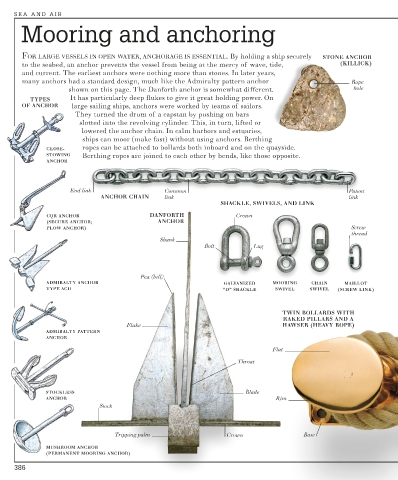
       Mooring and anchoring


       FOR LARGE VESSELS IN OPEN WATER, ANCHORAGE IS ESSENTIAL. By holding a ship securely   STONE ANCHOR
       to the seabed, an anchor prevents the vessel from being at the mercy of wave, tide,      (KILLICK)
       and current. The earliest anchors were nothing more than stones. In later years,
       many anchors had a standard design, much like the Admiralty pattern anchor                  Rope
                    shown on this page. The Danforth anchor is somewhat different.                 hole
         TYPES       It has particularly deep flukes to give it great holding power. On
       OF ANCHOR     large sailing ships, anchors were worked by teams of sailors.
                      They turned the drum of a capstan by pushing on bars
                       slotted into the revolving cylinder. This, in turn, lifted or
                        lowered the anchor chain. In calm harbors and estuaries,
                        ships can moor (make fast) without using anchors. Berthing
              CLOSE-    ropes can be attached to bollards both inboard and on the quayside.
              STOWING   Berthing ropes are joined to each other by bends, like those opposite.
              ANCHOR


                    End link                   Common                                             Patent
                             ANCHOR CHAIN      link                                               link
                                                              SHACKLE, SWIVELS, AND LINK
              CQR ANCHOR                   DANFORTH                Crown
              (SECURE ANCHOR;                ANCHOR
              PLOW ANCHOR)                                                                         Screw
                                                                                                   thread
                                             Shank
                                                          Bolt         Lug


                                        Pea (bill)
              ADMIRALTY ANCHOR                                 GALVANIZED    MOORING    CHAIN    MAILLOT
              TYPE ACII                                        “D” SHACKLE   SWIVEL    SWIVEL  (SCREW LINK)


                                                                               TWIN BOLLARDS WITH
                                                                                RAKED PILLARS AND A
                                    Fluke                                      HAWSER (HEAVY ROPE)
              ADMIRALTY PATTERN
              ANCHOR
                                                                             Flat
                                                                   Throat


              STOCKLESS                                              Blade
              ANCHOR                                                          Rim
                             Stock


                                 Tripping palm                  Crown                Base
              MUSHROOM ANCHOR
              (PERMANENT MOORING ANCHOR)

     386

