


Page 420 - (DK) The Ultimate Visual Dictionary 2nd Ed.
P. 420
SEA AND AIR
                                                                     NPT 301 MODERN TURBOJET
       Jet engines                                              Fuel sprayer  Reverse-flow   Radial diffuser

                                                             Turbine rotor  combustion
                                                                            chamber      Centrifugal
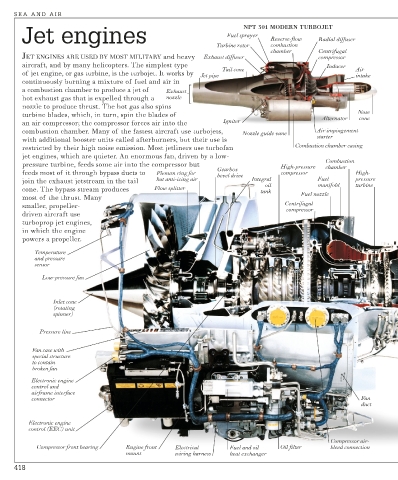
       JET ENGINES ARE USED BY MOST MILITARY and heavy    Exhaust diffuser               compressor
       aircraft, and by many helicopters. The simplest type                                 Inducer
                                                               Tail cone                            Air
       of jet engine, or gas turbine, is the turbojet. It works by   Jet pipe                       intake
       continuously burning a mixture of fuel and air in
       a combustion chamber to produce a jet of   Exhaust
       hot exhaust gas that is expelled through a   nozzle
       nozzle to produce thrust. The hot gas also spins
                                                                                                    Nose
       turbine blades, which, in turn, spin the blades of                                 Alternator  cone
       an air compressor; the compressor forces air into the   Igniter
       combustion chamber. Many of the fastest aircraft use turbojets,   Nozzle guide vane  Air impingement
       with additional booster units called afterburners, but their use is               starter
                                                                                   Combustion chamber casing
       restricted by their high noise emission. Most jetliners use turbofan
       jet engines, which are quieter. An enormous fan, driven by a low-
                                                                                           Combustion
       pressure turbine, feeds some air into the compressor but                High-pressure   chamber
                                                             Gearbox
       feeds most of it through bypass ducts to   Plenum ring for   bevel drive  compressor         High-
       join the exhaust jetstream in the tail   hot anti-icing air     Integral          Fuel       pressure
                                                                           oil           manifold   turbine
       cone. The bypass stream produces     Flow splitter                tank
       most of the thrust. Many                                                      Fuel nozzle
       smaller, propeller-                                                      Centrifugal
                                                                                 compressor
       driven aircraft use
       turboprop jet engines,
       in which the engine
       powers a propeller.
           Temperature
           and pressure
           sensor
             Low-pressure fan


                Inlet cone
                (rotating
                spinner)

            Pressure line

          Fan case with
          special structure
          to contain
          broken fan
          Electronic engine
          control and
          airframe interface
          connector                                                                                  Fan
                                                                                                     duct

         Electronic engine
         control (EEC) unit
                                                                                             Compressor air-
           Compressor front bearing  Engine front    Electrical   Fuel and oil   Oil filter  bleed connection
                                    mount         wiring harness  heat exchanger

     418

