


Page 490 - (DK) The Ultimate Visual Dictionary 2nd Ed.
P. 490
ARCHITECTURE
                                                                   Budlike
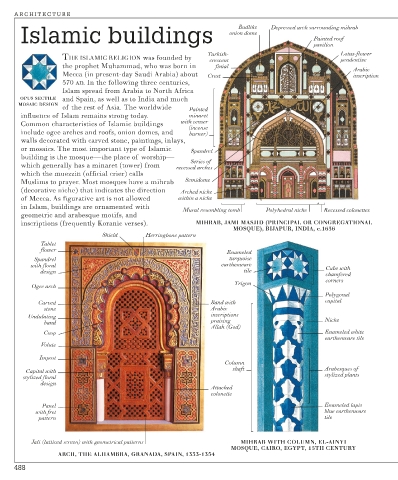
       Islamic buildings                                         onion dome  Depressed arch surrounding mihrab
                                                                                        Painted roof
                                                                                        pavilion
                                                           Turkish-                             Lotus-flower
                  THE ISLAMIC RELIGION was founded by
                                                           crescent                             pendentive
                  the prophet Muhammad, who was born in      finial
                                                                                                   Arabic
                  Mecca (in present-day Saudi Arabia) about   Crest                                inscription
                  570 ad. In the following three centuries,
                  Islam spread from Arabia to North Africa
       OPUS SECTILE   and Spain, as well as to India and much
      MOSAIC DESIGN
                  of the rest of Asia. The worldwide   Painted
       influence of Islam remains strong today.      minaret
       Common characteristics of Islamic buildings   with censer
                                                     (incense
       include ogee arches and roofs, onion domes, and   burner)
       walls decorated with carved stone, paintings, inlays,
       or mosaics. The most important type of Islamic
                                                      Spandrel
       building is the mosque—the place of worship—
                                                      Series of
       which generally has a minaret (tower) from   recessed arches
       which the muezzin (official crier) calls
       Muslims to prayer. Most mosques have a mihrab   Semidome
       (decorative niche) that indicates the direction   Arched niche
       of Mecca. As figurative art is not allowed   within a niche
       in Islam, buildings are ornamented with
                                                    Mural resembling tomb  Polyhedral niche  Recessed colonettes
       geometric and arabesque motifs, and
       inscriptions (frequently Koranic verses).       MIHRAB, JAMI MASJID (PRINCIPAL OR CONGREGATIONAL
                                                                  MOSQUE), BIJAPUR, INDIA, c.1636
                             Shield      Herringbone pattern
            Tablet
            flower
                                                                Enameled
           Spandrel                                              turquoise
          with floral                                         earthenware                  Cube with
            design                                                   tile
                                                                                           chamfered
                                                                                           corners
                                                                  Trigon
          Ogee arch
                                                                                           Polygonal
            Carved                                          Band with                      capital
             stone                                          Arabic
         Undulating                                         inscriptions                   Niche
             band                                           praising
                                                            Allah (God)
             Cusp                                                                          Enameled white
                                                                                           earthenware tile
            Volute
            Impost
                                                               Column
                                                                  shaft                    Arabesques of
        Capital with
       stylized floral                                                                     stylized plants
            design
                                                            Attached
                                                            colonette
             Panel                                                                         Enameled lapis
           with fret                                                                       blue earthenware
            pattern                                                                        tile


          Jali (latticed screen) with geometrical patterns          MIHRAB WITH COLUMN, EL-AINYI
                                                                 MOSQUE, CAIRO, EGYPT, 15TH CENTURY
                 ARCH, THE ALHAMBRA, GRANADA, SPAIN, 1333-1354

     488

