


Page 494 - (DK) The Ultimate Visual Dictionary 2nd Ed.
P. 494
ARCHITECTURE

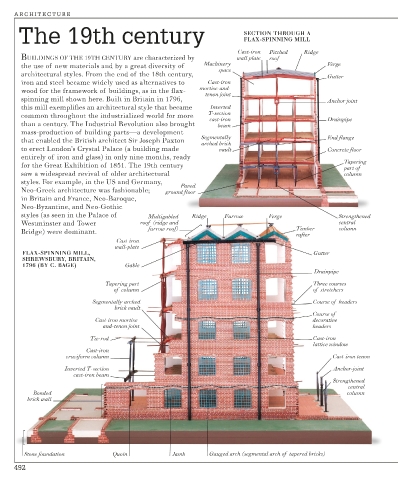
      The 19th century                                               SECTION THROUGH A
                                                                     FLAX-SPINNING MILL

                                                                   Cast-iron   Pitched   Ridge
       BUILDINGS OF THE 19TH CENTURY are characterized by          wall plate  roof
       the use of new materials and by a great diversity of   Machinery                     Verge
                                                              space
       architectural styles. From the end of the 18th century,                              Gutter
       iron and steel became widely used as alternatives to   Cast-iron
       wood for the framework of buildings, as in the flax-  mortise-and-
                                                          tenon joint
       spinning mill shown here. Built in Britain in 1796,                                  Anchor joint
       this mill exemplifies an architectural style that became   Inverted
                                                           T-section
       common throughout the industrialized world for more
                                                           cast-iron                        Drainpipe
       than a century. The Industrial Revolution also brought   beam
       mass-production of building parts—a development
                                                         Segmentally                        End flange
       that enabled the British architect Sir Joseph Paxton
                                                         arched brick
       to erect London’s Crystal Palace (a building made      vault                         Concrete floor
       entirely of iron and glass) in only nine months, ready
                                                                                                 Tapering
       for the Great Exhibition of 1851. The 19th century
                                                                                                 part of
       saw a widespread revival of older architectural                                           column
       styles. For example, in the US and Germany,
                                                   Paved
       Neo-Greek architecture was fashionable;   ground floor
       in Britain and France, Neo-Baroque,
       Neo-Byzantine, and Neo-Gothic
       styles (as seen in the Palace of   Multigabled    Ridge  Furrow      Verge              Strengthened
       Westminster and Tower            roof  (ridge and                                       central
                                          furrow roof)                             Timber      column
       Bridge) were dominant.
                                                                                   rafter
                                 Cast-iron
                                 wall-plate
       FLAX-SPINNING MILL,                                                              Gutter
       SHREWSBURY, BRITAIN,
       1796 (BY C. BAGE)            Gable
                                                                                        Drainpipe
                              Tapering part                                             Three courses
                                 of  column                                             of  stretchers
                           Segmentally arched                                           Course of  headers
                                 brick vault
                                                                                        Course of
                           Cast-iron mortise-                                           decorative
                              and-tenon joint                                           headers
                          Tie-rod                                                       Cast-iron
                                                                                        lattice window
                         Cast-iron
                   cruciform column                                                          Cast-iron tenon
                   Inverted T-section                                                         Anchor-joint
                     cast-iron beam
                                                                                             Strengthened
                                                                                                  central
          Bonded                                                                                 column
         brick wall


        Stone foundation        Quoin            Jamb      Gauged arch (segmental arch of  tapered bricks)

     492

