


Page 496 - (DK) The Ultimate Visual Dictionary 2nd Ed.
P. 496
ARCHITECTURE

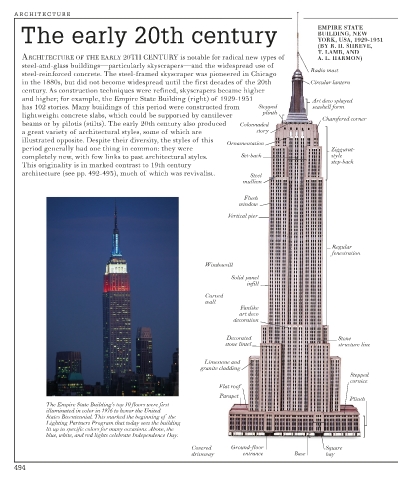
       The early 20th century                                                            EMPIRE STATE
                                                                                         BUILDING, NEW
                                                                                         YORK, USA, 1929-1931
                                                                                         (BY R. H. SHREVE,
                                                                                         T. LAMB, AND
       ARCHITECTURE OF THE EARLY 20TH CENTURY is notable for radical new types of        A. L. HARMON)
       steel-and-glass buildings—particularly skyscrapers—and the widespread use of
                                                                                       Radio mast
       steel-reinforced concrete. The steel-framed skyscraper was pioneered in Chicago
       in the 1880s, but did not become widespread until the first decades of the 20th   Circular lantern
       century. As construction techniques were refined, skyscrapers became higher
       and higher; for example, the Empire State Building (right) of 1929-1931          Art deco splayed
       has 102 stories. Many buildings of this period were constructed from   Stepped   seashell form
       lightweight concrete slabs, which could be supported by cantilever   plinth
                                                                                           Chamfered corner
       beams or by pilotis (stilts). The early 20th century also produced    Colonnaded
       a great variety of architectural styles, some of which are       story
       illustrated opposite. Despite their diversity, the styles of this
                                                                Ornamentation
       period generally had one thing in common: they were                                   Ziggurat-
       completely new, with few links to past architectural styles.    Set-back              style
                                                                                             step-back
       This originality is in marked contrast to 19th century
       architecture (see pp. 492-493), much of which was revivalist.   Steel
                                                                    mullion

                                                                     Flush
                                                                   window
                                                                Vertical pier


                                                                                             Regular
                                                                                             fenestration
                                                          Windowsill
                                                                 Solid-panel
                                                                      infill
                                                          Curved
                                                          wall
                                                                    Fanlike
                                                                   art deco
                                                                  decoration

                                                                Decorated                      Stone
                                                                stone lintel                   structure line

                                                          Limestone and
                                                         granite cladding
                                                                                                  Stepped
                                                                                                  cornice
                                                              Flat roof
                                                              Parapet
                                                                                                  Plinth
              The Empire State Building’s top 30 floors were first
              illuminated in color in 1976 to honor the United
              States Bicentennial. This marked the beginning of  the
              Lighting Partners Program that today sees the building
              lit up in specific colors for many occasions. Above, the
              blue, white, and red lights celebrate Independence Day.
                                                      Covered    Ground-floor              Square
                                                      driveway      entrance       Base    bay

     494

