


Page 32 - History of War - Issue 29-16
P. 32
HEROES OF THE VICTORIA CROSS


                “In the long glorious

                history of the Royal
                 Marines there is no

                name or deed which,
                  in its character or

                consequences ranks
                       above this”

                       Winston Churchill


              Lützow bombarded HMS Lion with nine shells,
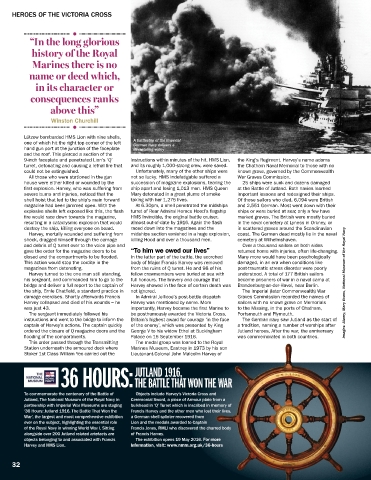
              one of which hit the right top corner of the left   A battleship of the Imperial
                                                    German Navy delivers a
              hand gun port at the junction of the faceplate   devastating volley
              and the roof. This pierced a section of the
              9-inch faceplate and penetrated Lion’s ‘Q’   instructions within minutes of the hit. HMS Lion,   the King’s Regiment. Harvey’s name adorns
              turret, detonating and causing a lethal   re that   and its roughly 1,000-strong crew, were saved.   the Chatham Naval Memorial to those with no
              could not be extinguished.             Unfortunately, many of the other ships were   known grave, governed by the Commonwealth
               All those who were stationed in the gun   not so lucky. HMS Indefatigable suffered a   War Graves Commission.
              house were either killed or wounded by the   succession of magazine explosions, tearing the   25 ships were sunk and dozens damaged
                rst explosion. Harvey, who was suffering from   ship apart and losing 1,013 men. HMS Queen   at the Battle of Jutland. Both navies learned
              severe burns and injuries, noticed that the   Mary detonated in a great plume of smoke   important lessons and redesigned their ships.
              shell hoist that led to the ship’s main forward   taking with her 1,275 lives.   Of those sailors who died, 6,094 were British
              magazine had been jammed open. With the   At 6.30pm, a shell penetrated the midships   and 2,551 German. Most went down with their
              explosive shells left exposed like this, the   ash   turret of Rear Admiral Horace Hood’s   agship   ships or were buried at sea; only a few have
                re would race down towards the magazine,   HMS Invincible, the original battle cruiser,   marked graves. The British were mostly buried
              resulting in a cataclysmic explosion that would   almost out-of-date by 1916. Again the   ash   in the naval cemetery at Lyness in Orkney, or
              destroy the ship, killing everyone on board.   raced down into the magazines and the   in scattered graves around the Scandinavian
               Harvey, mortally wounded and suffering from   midships section vanished in a huge explosion,   coast. The German dead mostly lie in the naval
              shock, dragged himself through the carnage   killing Hood and over a thousand men.  cemetery at Wilhelmshaven.
              and debris of Q turret over to the voice pipe and                           Over a thousand sailors on both sides
              gave the order for the magazine doors to be   “To him we owed our lives”   returned home with injuries, often life-changing.
              closed and the compartments to be   ooded.   In the latter part of the battle, the scorched   Many more would have been psychologically
              This action would stop the cordite in the   body of Major Francis Harvey was removed   damaged, in an era when conditions like
              magazines from detonating.           from the ruins of Q turret. He and 98 of his   post-traumatic stress disorder were poorly
               Harvey turned to the one man still standing,   fellow crewmembers were buried at sea with   understood. A total of 177 British sailors
              his sergeant, and commanded him to go to the   full honours. The bravery and courage that   became prisoners of war in a naval camp at
              bridge and deliver a full report to the captain of   Harvey showed in the face of certain death was   Brandenburg-an-der-Havel, near Berlin.  Images: Alamy, Mary Evans, National Museum of the Royal Navy
              the ship, Ernle Chat  eld, a standard practice in   not ignored.            The Imperial (later Commonwealth) War
              damage exercises. Shortly afterwards Francis   In Admiral Jellicoe’s post-battle dispatch   Graves Commission recorded the names of
              Harvey collapsed and died of his wounds – he   Harvey was mentioned by name. More   sailors with no known grave on Memorials
              was just 43.                         importantly, Harvey became the   rst Marine to   to the Missing, in the ports of Chatham,
               The sergeant immediately followed his   be posthumously awarded the Victoria Cross,   Portsmouth and Plymouth.
              instructions and went to the bridge to inform the   Britain’s highest award for courage ‘in the face   The German navy saw Jutland as the start of
              captain of Harvey’s actions. The captain quickly   of the enemy’, which was presented by King   a tradition, naming a number of warships after
              ordered the closure of Q magazine doors and the  George V to his widow Ethel at Buckingham   Jutland heroes. After the war, the anniversary
                ooding of the compartments.        Palace on 15 September 1916.          was commemorated in both countries.
               This order passed through the Transmitting   The medal group was loaned to the Royal
              Station underneath the armoured deck where   Marines Museum, Eastney in 1973 by his son
              Stoker 1st Class William Yeo carried out the   Lieutenant-Colonel John Malcolm Harvey of

                                                     JUTLAND 1916,

                           36 HOURS:  THE BATTLE THAT WON THE WAR

              To commemorate the centenary of the Battle of   Objects include Harvey’s Victoria Cross and
              Jutland, The National Museum of the Royal Navy in   Ceremonial Sword, a piece of Armour plate from a
              partnership with Imperial War Museums are staging   bulkhead in ‘Q’ Turret which is inscribed in memory of
              ‘36 Hours: Jutland 1916, The Battle That Won the   Francis Harvey and the other men who lost their lives,
              War’, the largest and most comprehensive exhibition   a German shell splinter recovered from
              ever on the subject, highlighting the essential role   Lion and the medals awarded to Captain
              of the Royal Navy in winning World War I. Sitting   Francis Jones, RMLI who discovered the charred body
              alongside over 200 Jutland related artefacts are   of Francis Harvey.
              objects belonging to and associated with Francis   The exhibition opens 19 May 2016. For more
              Harvey and HMS Lion.                 information, visit: www.nmrn.org.uk/36-hours


         32


       028-032_HOW029_VC_Hero.indd   32                                                                                      04/05/2016   20:52

