


Page 30 - History of War - Issue 29-16
P. 30
HEROES OF THE VICTORIA CROSS

              Joining HMS Lion
              Lion, under the command of Admiral David   The HMS Queen Mary’s
              Beatty, was armed with eight 13.5 inch guns   magazines detonate, causing the
              and Harvey’s of  ce was positioned under ‘Q’   ship to be ripped apart
              turret where he directed the guns operation
              and   re. As well as his duties here, however,
              he continued to serve as the senior marine
              of  cer on board right through his   rst military
              campaign, World War I.
               It was not long before Harvey saw action.
              At the Battle of Heligoland Bight on 28 August
              1914, HMS Lion, HMS Queen Mary and HMS
              Princess Royal sped into the Heligoland Bight,
              joining the British and German forces already
              engaged in an embittered   ght. Luckily, due to
              the poor weather, Beatty’s battle cruisers were
              able to surprise and destroy SMS Cölin and
              SMS Ariadne, with Harvey’s guns scoring many
              of the hits.
               On 24 January 1915, Harvey once again saw
              action when he faced Rear Admiral Franz von
              Hipper and his German battle cruiser squadron
              who had crossed the North Sea and repeatedly
              bombarded British coastal towns including
              Scarborough, Hartlepool and Whitby. The
              British and German squadrons came to blows
              at the Battle of Dogger Bank.
               During the   ght one of HMS Lion’s shots hit
              one of SMS Seydlitz’s turrets. A huge explosion
              ensued, destroying the adjacent turret and
              killing 160 men. The German   agship only   ‘Der Tag’ arrives               In January 1916, Vice Admiral Reinhard
              survived due to the actions of sailor Wilhelm   In the event of war, Britain had long-standing   Scheer took command of the German High
              Heidkamp, who   ooded the magazines. This   plans to blockade Germany economically,   Seas Fleet and swiftly devised a plan to
              action would later be mirrored by Harvey on the   cutting off vital imports from the Americas.   provoke the British into making a mistake.
              HMS Lion.                            A ‘distant blockade’ was planned, keeping   Hipper’s battle cruisers were to attack
               After the battle, he continued to serve aboard  the Grand Fleet at Scapa Flow in the Orkney   British convoys of merchant ships en route
              HMS Lion at Rosyth into May 1916, resuming   Islands. This gave Germany access to the North  to neutral Norway. Scheer expected Beatty
              his gunnery training and preparing for major   Sea, but Britain could still capture or sink her   to engage Hipper with his Battle Cruiser Fleet
                eet action.                        merchant ships.                       from Rosyth, to be joined later by Commander-
                                                                                         in-Chief, Admiral Sir John Jellicoe from Scapa
                                                                                         Flow. German submarines would ambush the
                                                                                         emerging   eets, and Hipper would engage
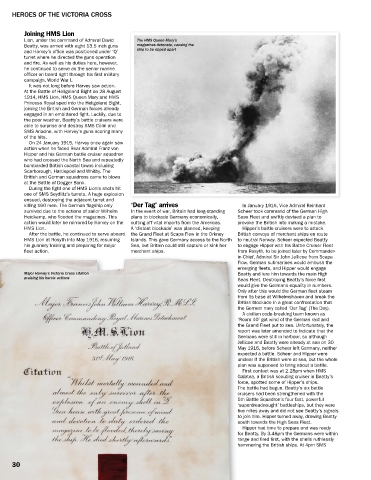
              Major Harvey’s Victoria Cross citation                                     Beatty and lure him towards the main High
              praising his heroic actions                                                Seas Fleet. Destroying Beatty’s force   rst
                                                                                         would give the Germans equality in numbers.
                                                                                         Only after this would the German   eet steam
                                                                                         from its base at Wilhelmshaven and break the
                                                                                         British blockade in a great confrontation that
                                                                                         the German navy called ‘Der Tag’ (The Day).
                                                                                          A civilian code-breaking team known as
                                                                                         ‘Room 40’ got wind of the German raid and
                                                                                         the Grand Fleet put to sea. Unfortunately, the
                                                                                         report was later amended to indicate that the
                                                                                         Germans were still in harbour, so although
                                                                                         Jellicoe and Beatty were already at sea on 30
                                                                                         May 1916, before Scheer left Germany, neither
                                                                                         expected a battle. Scheer and Hipper were
                                                                                         unclear if the British were at sea, but the whole
                                                                                         plan was supposed to bring about a battle.
                                                                                          First contact was at 2.28pm when HMS
                                                                                         Galatea, a British scouting cruiser in Beatty’s
                                                                                         force, spotted some of Hipper’s ships.
                                                                                         The battle had begun. Beatty’s six battle
                                                                                         cruisers had been strengthened with the
                                                                                         5th Battle Squadron’s four fast, powerful
                                                                                         ‘superdreadnought’ battleships, but they were
                                                                                           ve miles away and did not see Beatty’s signals
                                                                                         to join him. Hipper turned away, drawing Beatty
                                                                                         south towards the High Seas Fleet.
                                                                                          Hipper had time to prepare and was ready
                                                                                         for Beatty. By 3.48pm the Germans were within
                                                                                         range and   red   rst, with the shells ruthlessly
                                                                                         hammering the British ships. At 4pm SMS


         30


       028-032_HOW029_VC_Hero.indd   30                                                                                      04/05/2016   16:15

