


Page 56 - History of War - Issue 29-16
P. 56
JOHN, DUKE OF BEDFORD

              divided his lands into two governments. Henry   1423 and Bedford then intended to build up his   these troops were Scottish under the command
              V’s youngest brother, Humphrey, ran England,   army for a decisive stroke against the Dauphin.   of the Earls of Douglas and Buchan. The Scots
              while Bedford was named as Regent of France.   His plan revolved around strengthening   were vigorous allies of the French and had
              This was by far the hardest assignment,   Normandy’s frontiers by occupying Picardy and   been a considerable thorn in the side of the
              as Bedford had to continue his brother’s   driving French troops from key towns on the   English for decades, and the Dauphin had even
              conquests in the face of stiff opposition by   River Somme. To achieve this, Bedford laid   appointed Buchan as Constable of France.
              those who regarded Charles VI’s son, the   siege to Ivry, a town 30 miles west of Paris, but   Viscount d’Aumale was commanding this
              Dauphin, as the true king of France.   the French immediately captured the Norman   coalition army, but the Scots had a great
               One Victorian historian said Bedford was, “at   border town of Verneuil in August 1424. Ivry   degree of in  uence. For Bedford, the battle
              once prime minister and commander-in-chief,   surrendered on 14 August and Bedford rushed   would be personal, as it was a Scottish force
              he was virtually king of France.” Additionally,   his army to recapture Verneuil. The battle that   that had killed his elder brother, Thomas, Duke
              Bedford had to maintain a tenuous alliance   would take place outside its walls would secure   of Clarence, at the Battle of Baugé in 1421.
              with the Duke of Burgundy. Burgundian support   Bedford’s reputation.       A Burgundian eyewitness, Jean de Waurin,
              was essential to Bedford as the English did not                            who fought for the English, described the
              have a numerical superiority in France, but the   The ‘Second Agincourt’   Anglo-Scottish enmity during the battle: “The
              alliance was shaky as Burgundy was a semi-  On 17 August, Bedford’s army of approximately   English archers, and the Scots who were with
              dependent duchy and its duke was a slippery   9,600 men lined up across the north road out   the French, began to shoot each other so
              character who changed sides depending on the   of  . He arranged his army in the ‘Agincourt’   cruelly that it was horrible to look at them.
              political climate. This meant that the English   formation with his men-at-arms in the centre   They brought death with full force to those
              took on the bulk of the military offensive   and the famous archers on the   anks. There   they attacked. After the shooting the parties
              against ‘Dauphinist’ French armies.   was also a reserve of 2,000 archers who   attacked each other furiously, hand to hand.”
               Under Bedford’s leadership the English   formed a laager of wagons and horses to   Waurin, who had fought at Agincourt, stated
              armies had continued success in France. An   defend the baggage train.     that Verneuil was a more ferocious battle:
              Anglo-Burgundian army defeated a numerically   Facing the English was a ‘French’ army of   “Without doubt, I have never seen a   ner
              superior Franco-Scottish army at Cravant in July   about 14-16,000 men but 6,000 of   company where there were so many nobles
                                                                                           showing greater appearance of wanting to
                                                                                             ght. I saw the assembly of Agincourt, but
                                                                                           the assembly at Verneuil was the most
                                                                                            formidable and the best fought.”
                                                                                             He went on to state: “This battle lasted
                                                                                            about three-quarters of an hour, very
                                                                                            terrible and bloody, and it was not in the
                                                                                            memory of man to have two such mighty
                                                                                            parties   ghting for such a space of time
                                                                                            without being able to tell to whom the loss
                                                                                            or victory would turn…”
                                                                                             Eventually, however, victory turned
                                                                                            decisively for the English. As at Agincourt,
                                                                                           the archers played a part in the success
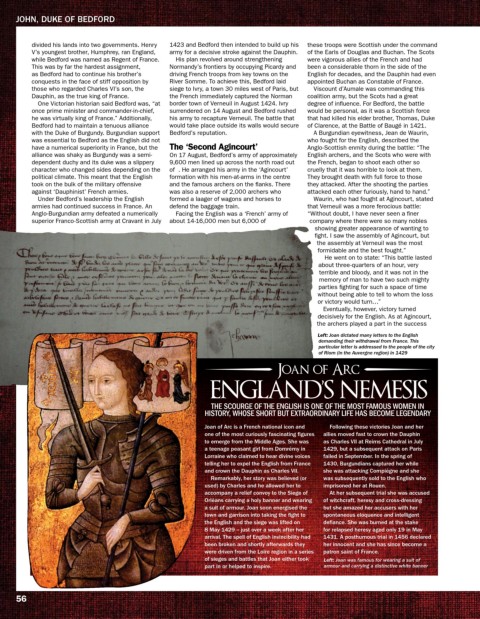
                                                                                            Left: Joan dictated many letters to the English
                                                                                            demanding their withdrawal from France. This
                                                                                            particular letter is addressed to the people of the city
                                                                                            of Riom (in the Auvergne region) in 1429
                                                                                 Joan of Arc

                                                              ENGLAND’S NEMESIS


                                                               THE SCOURGE OF THE ENGLISH IS ONE OF THE MOST FAMOUS WOMEN IN
                                                             HISTORY, WHOSE SHORT BUT EXTRAORDINARY LIFE HAS BECOME LEGENDARY
                                                             Joan of Arc is a French national icon and   Following these victories Joan and her
                                                             one of the most curiously fascinating   gures   allies moved fast to crown the Dauphin
                                                             to emerge from the Middle Ages. She was   as Charles VII at Reims Cathedral in July
                                                             a teenage peasant girl from Domrémy in   1429, but a subsequent attack on Paris
                                                             Lorraine who claimed to hear divine voices   failed in September. In the spring of
                                                             telling her to expel the English from France   1430, Burgundians captured her while
                                                             and crown the Dauphin as Charles VII.   she was attacking Compiégne and she
                                                              Remarkably, her story was believed (or   was subsequently sold to the English who
                                                             used) by Charles and he allowed her to   imprisoned her at Rouen.
                                                             accompany a relief convoy to the Siege of   At her subsequent trial she was accused
                                                             Orléans carrying a holy banner and wearing   of witchcraft, heresy and cross-dressing
                                                             a suit of armour. Joan soon energised the   but she amazed her accusers with her
                                                             town and garrison into taking the   ght to   spontaneous eloquence and intelligent
                                                             the English and the siege was lifted on   de  ance. She was burned at the stake
                                                             8 May 1429 – just over a week after her   for relapsed heresy aged only 19 in May
                                                             arrival. The spell of English invincibility had   1431. A posthumous trial in 1456 declared
                                                             been broken and shortly afterwards they   her innocent and she has since become a
                                                             were driven from the Loire region in a series   patron saint of France.
                                                             of sieges and battles that Joan either took   Left: Joan was famous for wearing a suit of
                                                             part in or helped to inspire.   armour and carrying a distinctive white banner


         56


       052-057_HOW029_Il_Duce_of_Bedford.indd   56                                                                           04/05/2016   16:19

