


Page 60 - History of War - Issue 29-16
P. 60
TE LAWRENCE

              who held disparate tribal allegiances and
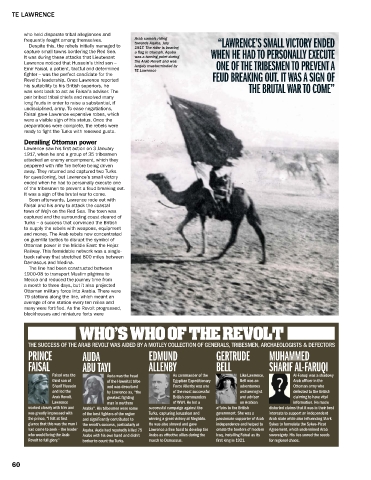
              frequently fought among themselves.    Arab camels riding           “LAWRENCE’S SMALL VICTORY ENDED
               Despite this, the rebels initially managed to   towards Aqaba, July
                                                     1917. The rider is bearing
              capture small towns bordering the Red Sea.   a   ag in triumph. Aqaba   WHEN HE HAD TO PERSONALLY EXECUTE
              It was during these attacks that Lieutenant   was a turning point during
              Lawrence noticed that Hussein’s third son –   the Arab Revolt and was   ONE OF THE TRIBESMEN TO PREVENT A
              Emir Faisal, a patient, tactful and determined   largely masterminded by
                                                     TE Lawrence
                ghter – was the perfect candidate for the                       FEUD BREAKING OUT. IT WAS A SIGN OF
              Revolt’s leadership. Once Lawrence reported
              his suitability to his British superiors, he                                   THE BRUTAL WAR TO COME”
              was sent back to act as Faisal’s adviser. The
              pair bribed tribal chiefs and resolved many
              long feuds in order to raise a substantial, if
              undisciplined, army. To ease negotiations,
              Faisal gave Lawrence expensive robes, which
              were a visible sign of his status. Once the
              preparations were complete, the rebels were
              ready to   ght the Turks with renewed gusto.
              Derailing Ottoman power
              Lawrence saw his   rst action on 3 January
              1917, when he and a group of 35 tribesmen
              attacked an enemy encampment, which they
              peppered with ri  e   re before being driven
              away. They returned and captured two Turks
              for questioning, but Lawrence’s small victory
              ended when he had to personally execute one
              of the tribesmen to prevent a feud breaking out.
              It was a sign of the brutal war to come.
               Soon afterwards, Lawrence rode out with
              Faisal and his army to attack the coastal
              town of Wejh on the Red Sea. The town was
              captured and the surrounding coast cleared of
              Turks – a success that convinced the British
              to supply the rebels with weapons, equipment
              and money. The Arab rebels now concentrated
              on guerrilla tactics to disrupt the symbol of
              Ottoman power in the Middle East: the Hejaz
              Railway. This formidable network was a single-
              track railway that stretched 800 miles between
              Damascus and Medina.
               The line had been constructed between
              1900-08 to transport Muslim pilgrims to
              Mecca and reduced the journey time from
              a month to three days, but it also projected
              Ottoman military force into Arabia. There were
              79 stations along the line, which meant an
              average of one station every ten miles and
              many were forti  ed. As the Revolt progressed,
              blockhouses and miniature forts were
                                 WHO’S WHO OF THE REVOLT


               THE SUCCESS OF THE ARAB REVOLT WAS AIDED BY A MOTLEY COLLECTION OF GENERALS, TRIBESMEN, ARCHAEOLOGISTS & DEFECTORS
               PRINCE             AUDA                    EDMUND                 GERTRUDE           MUHAMMED
               FAISAL             ABU TAYI                ALLENBY                BELL               SHARIF AL-FARUQI

                        Faisal was the     Auda was the head      As commander of the     Like Lawrence,    Al-Faruqi was a shadowy
                        third son of       of the Howeitat tribe   Egyptian Expeditionary   Bell was an     Arab of  cer in the
                        Sharif Hussein     and was described      Force Allenby was one   adventurous       Ottoman army who
                        and led the        by Lawrence as, “the   of the most successful   archaeologist    defected to the British
                        Arab Revolt.       greatest   ghting      British commanders      and adviser       claiming to have vital
                        Lawrence           man in northern        of WWI. He led a        on Arabian        information. He made
               worked closely with him and   Arabia”. His tribesmen were some   successful campaign against the   affairs to the British   distorted claims that it was in their best
               was greatly impressed with   of the best   ghters of the region   Turks, capturing Jerusalem and   government. She was a   interests to support an independent
               the prince, “I felt at   rst   and signi  cantly contributed to   winning a great victory at Megiddo.   passionate supporter of Arab  Arab state while also in  uencing Mark
               glance that this was the man I  the revolt’s success, particularly at   He was also shrewd and gave   independence and helped to   Sykes to formulate the Sykes-Picot
               had come to seek – the leader  Aqaba. Auda had reputedly killed 75   Lawrence a free hand to develop the   create the borders of modern  Agreement, which undermined Arab
               who would bring the Arab   Arabs with his own hand and didn’t   Arabs as effective allies during the   Iraq, installing Faisal as its   sovereignty. His lies sowed the seeds
               Revolt to full glory.”   bother to count the Turks.   march to Damascus.     rst king in 1921.   for regional chaos.


         60


       058-065_HOW029_Lawrence_of_Arabia.indd   60                                                                           04/05/2016   18:34

