


Page 112 - (DK Eyewitness) Travel Guide - Austria
P. 112
110 VIENNA AREA B Y AREA
w Zentralfriedhof
Austria’s largest burial ground, containing 300,000
graves – the largest number of any cemetery in
Europe – and covering over 2.5 sq km (1 sq mile),
was opened in 1874. The central section includes
the graves of artists, composers, architects, writers
and local politicians. Funerals in Vienna are often
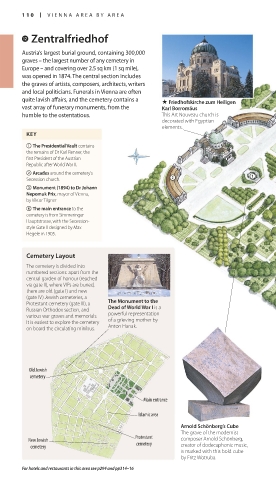
quite lavish affairs, and the cemetery contains a . Friedhofskirche zum Heiligen
vast array of funerary monuments, from the Karl Borromäus
humble to the ostentatious. This Art Nouveau church is
decorated with Egyptian
elements.
KEY
1 The Presidential Vault contains
the remains of Dr Karl Renner, the
first President of the Austrian
Republic after World War II.
2 Arcades around the cemetery’s
Secession church.
3 Monument (1894) to Dr Johann
Nepomuk Prix, mayor of Vienna,
by Viktor Tilgner
4 The main entrance to the
cemetery is from Simmeringer
Hauptstrasse, with the Secession-
style Gate II designed by Max
Hegele in 1905.
Cemetery Layout
The cemetery is divided into
numbered sections: apart from the
central garden of honour (reached
via gate II), where VIPs are buried,
there are old (gate I) and new
(gate IV) Jewish cemeteries, a
Protestant cemetery (gate III), a The Monument to the
Russian Orthodox section, and Dead of World War I is a
various war graves and memorials. powerful representation
It is easiest to explore the cemetery of a grieving mother by
on board the circulating minibus. Anton Hanak.
Old Jewish
cemetery
Main entrance
Islamic area
Arnold Schönberg’s Cube
The grave of the modernist
Protestant
New Jewish composer Arnold Schönberg,
cemetery cemetery creator of dodecaphonic music,
is marked with this bold cube
by Fritz Wotruba.
For hotels and restaurants in this area see p294 and pp314–16
110-111_EW_Austria.indd 110 12/09/17 3:03 pm
Eyewitness Travel LAYERS PRINTED:
Starsight template “UK” LAYER
(Source v2.8)
Date 15th May 2013
Size 125mm x 217mm

