


Page 108 - (DK Eyewitness) Travel Guide - Austria
P. 108
106 VIENNA AREA B Y AREA
villages in the area around
Vienna, but undoubtedly the
most famous of all is Grinzing.
Although it may have lost some
of its original charm, this is still a
nice place to spend an evening.
On the way to Grinzing, it is
worth taking the time to visit
the Heiligenstädter Testament-
Haus at No. 6 on the narrow
Probusgasse – Ludwig van
Beethoven’s most famous home
in Vienna. It was here that the
great composer tried to find a
cure for his worsening deafness;
when he failed, he wrote a
Cobenzlgasse, one of the charming streets in Grinzing dramatic letter to his brothers,
known as The Testament.
1 Kahlenberg 2 Grinzing
@ 38A. v 38. @ 38A.
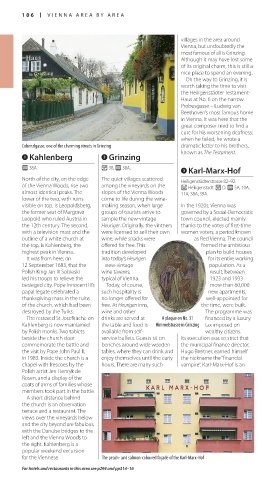
3 Karl-Marx-Hof
North of the city, on the edge The quiet villages scattered Heiligenstädterstrasse 82–92.
of the Vienna Woods, rise two among the vineyards on the % Heiligenstadt. v D. @ 5A, 10A,
almost identical peaks. The slopes of the Vienna Woods 11A, 38A, 39A.
lower of the two, with ruins come to life during the wine-
visible on top, is Leopoldsberg, making season, when large In the 1920s, Vienna was
the former seat of Margrave groups of tourists arrive to governed by a Social-Democratic
Leopold who ruled Austria in sample the new-vintage town council, elected mainly
the 12th century. The second, Heuriger. Originally, the vintners thanks to the votes of first-time
with a television mast and the were licensed to sell their own women voters, a period known
outline of a white church at wine, while snacks were as Red Vienna. The council
the top, is Kahlenberg, the offered for free. This formed the ambitious
highest peak in Vienna. tradition developed plan to build houses
It was from here, on into today’s Heurigen for its entire working
12 September 1683, that the – new-vintage population. As a
Polish King Jan III Sobieski wine taverns, result, between
led his troops to relieve the typical of Vienna. 1923 and 1933
besieged city. Pope Innocent III’s Today, of course, more than 60,000
papal legate celebrated a such hospitality is new apartments,
thanksgiving mass in the ruins no longer offered for well-appointed for
of the church, which had been free. At Heurigen inns, the time, were built.
destroyed by the Turks. wine and other The programme was
The restored St Josefkirche on drinks are served at A plaque on No. 31 financed by a luxury
Kahlenberg is now maintained the table and food is Himmelstrasse in Grinzing tax imposed on
by Polish monks. Two tablets available from self- wealthy citizens.
beside the church door service buffets. Guests sit on Its execution was so strict that
commemorate the battle and benches around wide wooden the municipal finance director,
the visit by Pope John Paul II, tables, where they can drink and Hugo Breitner, earned himself
in 1983. Inside the church is a enjoy themselves until the early the nickname the “financial
chapel with frescoes by the hours. There are many such vampire”. Karl-Marx-Hof is an
Polish artist Jen Henryk de
Rosen, and a display of the
coats of arms of families whose
members took part in the battle.
A short distance behind
the church is an observation
terrace and a restaurant. The
views over the vineyards below
and the city beyond are fabulous,
with the Danube bridges to the
left and the Vienna Woods to
the right. Kahlenberg is a
popular weekend excursion
for the Viennese. The peach- and salmon-coloured façade of the Karl-Marx-Hof
For hotels and restaurants in this area see p294 and pp314–16
106-107_EW_Austria.indd 106 12/09/17 3:03 pm

