


Page 151 - (DK Eyewitness) Travel Guide - Austria
P. 151
L OWER A USTRIA AND BURGENLAND 149
Benedictine Abbeys
Benedictine monasticism was established whose history was chronicled by the
in the 6th century, in Italy, by St Benedict Benedictines. Fortified abbeys were
of Nursia, and its mother abbey was Monte built on unassailable hilltops, and rural
Cassino. The first Benedictine abbey in settlements grew up in the shadow,
Austria was founded in the 8th century, and under the protection of, the abbeys.
in Salzburg, but it was not until the 11th The beautiful silhouettes of the abbey
century that the order became a major buildings tower over their surroundings.
force. Its growth was linked to the increased Stunningly decorated inside, they boast
importance given to the Austrian state marvellous libraries that house
under the rule of the Babenbergs, outstanding records of the past.
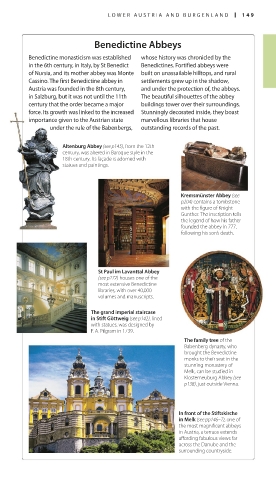
Altenburg Abbey (see p145), from the 12th
century, was altered in Baroque style in the
18th century. Its façade is adorned with
statues and paintings.
Kremsmünster Abbey (see
p204) contains a tombstone
with the figure of Knight
Gunther. The inscription tells
the legend of how his father
founded the abbey in 777,
following his son’s death.
St Paul im Lavanttal Abbey
(see p272) houses one of the
most extensive Benedictine
libraries, with over 40,000
volumes and manuscripts.
The grand imperial staircase
in Stift Göttweig (see p142), lined
with statues, was designed by
F. A. Pilgram in 1739.
The family tree of the
Babenberg dynasty, who
brought the Benedictine
monks to their seat in the
stunning monastery of
Melk, can be studied in
Klosterneuburg Abbey (see
p138), just outside Vienna.
In front of the Stiftskirche
in Melk (see pp146–7), one of
the most magnificent abbeys
in Austria, a terrace extends
affording fabulous views far
across the Danube and the
surrounding countryside.
148-149_EW_Austria.indd 149 12/09/17 3:03 pm

