


Page 152 - (DK Eyewitness) Travel Guide - Austria
P. 152
150 A USTRIA REGION B Y REGION
p Neuhofen an Ostarrichi. According to the
der Ybbs most widely believed
interpretation,
Road map E3. * 2,900. @ it meant “eastern
n (07475) 52700-40. territories”, but an
∑ neuhofen-ybbs.at
alternative view also
exists: at the time
Neuhofen is a small town on when the name
the Ybbs river, in the foothills Ostarrichi first appeared,
of the Alps. Its centre is the area in this part of
occupied by a Gothic church the Danube valley was
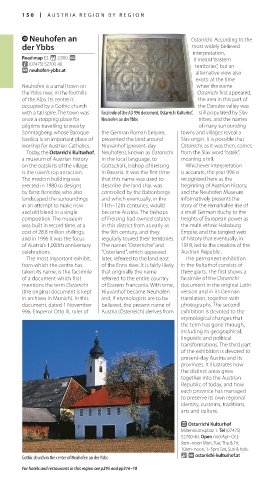
with a tall spire. The town was Facsimile of the AD 996 document, Ostarrichi Kulturhof, still populated by Slav
once a stopping place for Neuhofen an der Ybbs tribes, and the names
pilgrims travelling to nearby of many surround ing
Sonntagberg, whose Baroque the German Roman Empire, towns and villages reveal a
basilica is an important place of presented the land around Slav origin. It is possible that
worship for Austrian Catholics. Niuvanhof (present-day Ostarrichi, as it was then, comes
Today, the Ostarrichi Kulturhof, Neuhofen), known as Ostarrichi from the Slav word “ostrik”,
a museum of Austrian history in the local language, to meaning a hill.
on the outskirts of the village, Gottschalk, bishop of Freising Whichever interpretation
is the town’s top attrac tion. in Bavaria. It was the first time is accurate, the year 996 is
The modern building was that this name was used to recognized here as the
erected in 1980 to designs describe the land that was beginning of Austrian history,
by Ernst Beneder, who also controlled by the Babenbergs and the Neuhofen Museum
land scaped the surroundings and which eventually, in the informa tively presents the
in an attempt to make new 11th–12th centuries, would story of the remarkable rise of
and old blend in a single become Austria. The bishops a small German duchy to the
composition. The museum of Freising had owned estates heights of European power as
was built in record time, at a in this district from as early as the multi-ethnic Habsburg
cost of 28.8 million shillings, the 9th century, and they Empire, and the tangled web
and in 1996 it was the focus regularly toured their territories. of history that eventually, in
of Austria’s 1,000th anniversary The names “Osterriche” and 1918, led to the creation of the
celebrations. “Osterland”, which appeared Austrian Republic.
The most important exhibit, later, referred to the land east The permanent exhibition
from which the centre has of the Enns river. It is fairly likely in the Kulturhof consists of
taken its name, is the facsimile that originally the name three parts. The first shows a
of a document which first referred to the entire country facsimile of the Ostarrichi
mentions the term Ostarrichi of Eastern Franconia. With time, document in the original Latin
(the original document is kept Niuvanhof became Neuhofen version and in its German
in archives in Munich). In this and, if etymologists are to be translation, together with
document, dated 1 November believed, the present name of photographs. The second
996, Emperor Otto III, ruler of Austria (Österreich) derives from exhibition is devoted to the
etymological changes that
the term has gone through,
including its geographical,
linguistic and political
transformations. The third part
of the exhibition is devoted to
present-day Austria and its
provinces. It illustrates how
the distinct areas grew
together into the Austrian
Republic of today, and how
each province has managed
to pre serve its own regional
identity, customs, traditions,
arts and culture.
E Ostarrichi Kulturhof
Millenniumsplatz 1. Tel (07475)
52700-40. Open mid-Apr–Oct:
9am–noon Mon, Tue, Thu & Fri;
10am–noon, 1–5pm Sat, Sun & hols.
& ∑ ostarrichi-kulturhof.at
Gothic church in the centre of Neuhofen an der Ybbs
For hotels and restaurants in this region see p295 and pp316–18
150-151_EW_Austria.indd 150 12/09/17 3:03 pm

