


Page 163 - (DK Eyewitness) Travel Guide - Austria
P. 163
A USTRIA REGION B Y REGION 161
STYRIA
Austria’s second-largest province, in the country’s
southeast, Styria has a population of 1.2 million.
It is dominated by forests, meadows and vineyards
cover ing some three-quarters of its total area of
16,387 sq km (6,327 sq miles). It is also an area of iron
ore extrac tion and processing, and Erzberg (Iron Ore
Mountain), glittering in every hue of red and brown, is a major tourist attraction.
Iron ore was first extracted by the capture the imagination of visitors
Romans, who named this part of Austria to the region.
the Roman province of Noricum. The Styria’s great attractions include the
mineral shaped the history of the south-facing slopes of Raxalpen, its
province through the centuries, and gentle climate and its rural idylls – it is
its traces survive to this day. Following known as “the green heart” of Austria.
the highs and lows of the early Middle In the west, along its border with the
Ages, Styria fell into the hands of the Salzburger Land, the area is dominated
Habsburg dynasty in the 13th century by the lofty peaks of the Salzburg
and shared in its fate and fortunes. Alps and Lower Tauern. Here you will
The province was repeatedly ravaged find excellent winter sport centres
by Hungarians and Turks, and, after around Schladming, and at the foot
having staved off the Turkish threat in of Dachstein, the highest peak in the
the 17th century, also became susceptible region, with the best cross-country-
to attacks by the French. skiing trails.
A legacy of these times are its numerous The Salzkammergut in the north is a
hilltop castle strongholds and imposing stunningly beautiful lake district. The
fortified abbeys. Some have survived province’s main rivers are the Mur,
intact, others have been meticulously which flows through Graz, its tributary
restored to their former splendour to the Mürz, and the Salza.
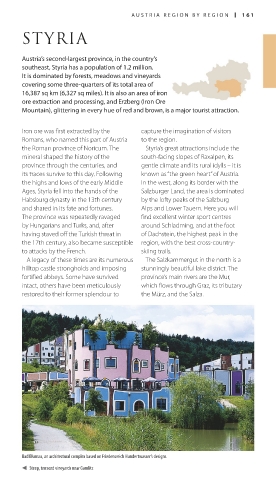
Bad Blumau, an architectural complex based on Friedensreich Hundertwasser’s designs
Steep, terraced vineyards near Gamlitz
160-161_EW_Austria.indd 161 12/09/17 3:03 pm

