


Page 168 - (DK Eyewitness) Travel Guide - Austria
P. 168
166 A USTRIA REGION B Y REGION
square, at No. 4, stands Graz’s
oldest pharmacy, in a house
dating from 1534 with some
earlier features. The south side of
the square is occupied by the
neo-Renaissance town hall, built
in the 1880s. In the middle of the
square stands the fountain of
Archduke Johann, who
contributed much to the city’s
development. The four female
figures around it symbolize
Styria’s four main rivers: the Mur,
the Enns, the Drau and the Sann.
E Universalmuseum
Joanneum
Old Gallery Schloss Eggenberg: see
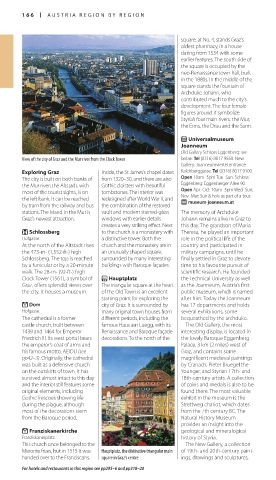
View of the city of Graz and the Mur river from the Clock Tower below. Tel (0316) 8017 9560. New
Gallery: Joanneumviertel entrance
Exploring Graz Inside, the St James’s chapel dates Kalchberggasse. Tel (0316) 8017 9100.
The city is built on both banks of from 1320–30, and there are also Open 10am–5pm Tue–Sun. Schloss
the Mur river; the Altstadt, with Gothic cloisters with beautiful Eggenberg: Eggenberger Allee 90.
most of the tourist sights, is on tombstones. The interior was Open Apr–Oct: 10am–5pm Wed–Sun;
Nov–Mar: Sun & hols as part of a tour.
the left bank. It can be reached redesigned after World War II, and ∑ museum-joanneum.at
by tram from the railway and bus the combination of the restored
stations. The Island in the Mur is vault and modern stained-glass The memory of Archduke
Graz’s newest attraction. windows with earlier details Johann remains alive in Graz to
creates a very striking effect. Next this day. The grandson of Maria
+ Schlossberg to the church is a monastery with Theresa, he played an important
Hofgasse. a distinctive tower. Both the role in the political life of the
At the north of the Altstadt rises church and the monastery are in country and participated in
the 473-m- (1,552-ft-) high an unusually shaped square, military campaigns, until he
Schloss berg. The top is reached surrounded by many interesting finally settled in Graz to devote
by a funicular or by a 20-minute buildings with Baroque façades. time to his favourite pursuit of
walk. The 28-m- (92-ft-) high scientific research. He founded
Clock Tower (1561), a symbol of P Hauptplatz the Technical University as well
Graz, offers splendid views over The triangular square at the heart as the Joanneum, Austria’s first
the city. It houses a museum. of the Old Town is an excellent public museum, which is named
starting point for exploring the after him. Today the Joanneum
R Dom city of Graz. It is surrounded by has 17 departments and holds
Hofgasse. many original town houses from several exhibitions, some
The cathedral is a former different periods, including the bequeathed by the archduke.
castle church, built between famous Haus am Luegg, with its The Old Gallery, the most
1439 and 1464 for Emperor Renaissance and Baroque façade inter esting display, is located in
Friedrich III. Its west portal bears decorations. To the north of the the lovely Baroque Eggenberg
the emperor’s coat of arms and Palace, 3 km (2 miles) west of
his famous motto, AEIOU (see Graz, and contains some
pp42–3). Originally, the cathedral magnifi cent medieval paintings
was built as a defensive church by Cranach, Pieter Bruegel the
on the outskirts of town. It has Younger, and Styrian 17th- and
survived almost intact to this day 18th-century artists. A collection
and the interior still features some of coins and medals is also to be
original elements, including found there. The most valuable
Gothic frescoes showing life exhibit in the museum is the
during the plague, although Strettweg chariot, which dates
most of the decorations stem from the 7th century BC. The
from the Baroque period. Natural History Museum
provides an insight into the
R Franziskanerkirche geological and mineralogical
Franziskanerplatz. history of Styria.
This church once belonged to the The New Gallery, a collection
Minorite friars, but in 1515 it was Hauptplatz, the distinctive triangular main of 19th- and 20th-century paint-
handed over to the Franciscans. square in Graz’s centre ings, drawings and sculptures,
For hotels and restaurants in this region see pp295–6 and pp318–20
166-167_EW_Austria.indd 166 12/09/17 2:45 pm

