


Page 169 - (DK Eyewitness) Travel Guide - Austria
P. 169
GR AZ 167
Johann Joachim Carlone.
The palace’s main features are
its monumental staircase with
frescoes and stucco ornaments,
and its richly ornamented
façades (inside and out, beyond
the drive). The uniform
furnishing of the rooms, with
ceiling stuccos and lovely
fireplaces and tiled stoves, is
testimony to the Austrian
aristocracy’s standard of living
during the Baroque period.
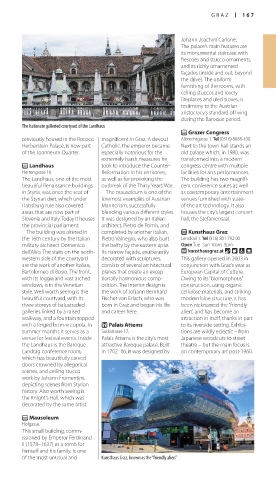
The Italianate galleried courtyard of the Landhaus
P Grazer Congress
previously housed in the Rococo magnificent in Graz. A devout Albrechtgasse 1. Tel (0316) 8088-400.
Herberstein Palace, is now part Catholic, the emperor became Next to the town hall stands an
of the Joanneum Quarter. especially notorious for the old palace which, in 1980, was
extremely harsh measures he transformed into a modern
P Landhaus took to introduce the Counter- congress centre with multiple
Herrengasse 16. Reformation in his territories, facilities for arts performances.
The Landhaus, one of the most as well as for provoking the The building has two magnifi-
beautiful Renaissance buildings outbreak of the Thirty Years’ War. cent conference suites as well
in Styria, was once the seat of The mausoleum is one of the as contemporary entertainment
the Styrian diet, which under foremost examples of Austrian venues furnished with state-
Habsburg rule also covered Mannerism, successfully of-the art technology. It also
areas that are now part of blending various different styles. houses the city’s largest concert
Slovenia and Italy. Today it houses It was designed by an Italian hall, the Stefaniensaal.
the provincial parliament. architect, Pietro de Pomis, and
The building was altered in completed by another Italian, E Kunsthaus Graz
the 16th century by the Italian Pietro Valnegro, who also built Lendkail 1. Tel (316) 801 792 00
military architect Domenico the belfry by the eastern apse. Open Tue–Sun 10am–5pm
dell’Allio. The stairs on the north- Its narrow façade, exuberantly ∑ kunsthausgraz.at & 8 7 -
western side of the courtyard decorated with sculptures, This gallery opened in 2003 in
are the work of another Italian, consists of several architectural conjunction with Graz’s year as
Bartolomeo di Bosio. The front, planes that create an excep- European Capital of Culture.
with its loggia and vast arched tionally harmonious comp- Owing to its “biomorphous”
windows, is in the Venetian osition. The interior design is construction, using organic
style. Well worth seeing is the the work of Johann Bernhard cellulose materials, and striking
beautiful courtyard, with its Fischer von Erlach, who was modern blue structure, it has
three storeys of balus traded born in Graz and began his life been nicknamed the “friendly
galleries linked by a raised and career here. alien”, and has become an
walkway, and a fountain topped attraction in itself, thanks in part
with a forged bronze cupola. In + Palais Attems to its riverside setting. Exhibi-
summer months it serves as a Sackstrasse 17. tions are wildly eclectic – from
venue for festival events. Inside Palais Attems is the city’s most Japanese woodcuts to street
the Landhaus is the Baroque attractive Baroque palace. Built theatre – but the main focus is
Landtag conference room, in 1702–16, it was desi gned by on contemporary art post-1960.
which has beautifully carved
doors crowned by allegorical
scenes, and ceiling stucco
work by Johann Fromentini,
depicting scenes from Styrian
history. Also worth seeing is
the Knight’s Hall, which was
decorated by the same artist.
P Mausoleum
Hofgasse.
This small building, comm-
issioned by Emperor Ferdinand
II (1578–1637) as a tomb for
himself and his family, is one
of the most unusual and Kunsthaus Graz, known as the “friendly alien”
166-167_EW_Austria.indd 167 12/09/17 2:45 pm

