


Page 28 - (DK Eyewitness) Travel Guide - Austria
P. 28
26 INTRODUCING A USTRIA
The Landscape of Austria
The Alpine belt stretches from the
Austria has a highly diverse landscape because of its zone of the mountain pine up to
the ice and snow fields. At altitudes
location at the junction of four regions. The north of the of 2,500–3,200 m (8,200–10,500 ft),
country is part of the Central European natural region, snow is present all year. This snow-
line is called the “nival belt”.
originally dominated by deciduous and mixed forests,
while the southern part belongs to the Alpine region.
The southeast lies in the Illyrian region, which benefits The transition zone
from a Mediterranean climate, resulting in a rich flora and between forest and Alpine
grassland is covered in
fauna including edible chestnuts and rare species of lizards scrub (dwarf mountain pine,
and snakes. The northeastern part of the country belongs rhododendron and alder).
to the Pontian-Pannonian region, with surviving species Here, the growing season
lasts only 70–100 days.
of steppe flora and characteristic fauna including the
suslik (a ground squirrel), hamster and great bustard.
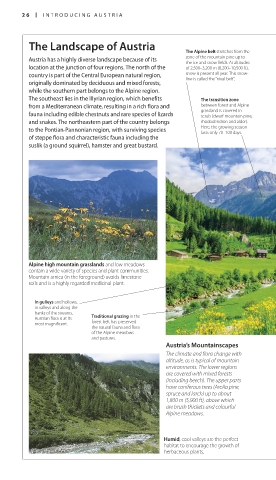
Alpine high mountain grasslands and low meadows
the natural fauna and flora contain a wide variety of species and plant communities.
of the Alpine meadows Mountain arnica (in the foreground) avoids limestone
and pastures.The transition zone between forests and Alpine soils and is a highly regarded medicinal plant.
grassland is covered in
scrub (dwarf mountain pine, rhododendron and alder). Here, the
growing season lasts only 70–100 days.In gulleys and hollows,
in valleys and along the banks of the streams, Austrian flora is at its In gulleys and hollows,
in valleys and along the
most magnificent.Upper forest region, mainly spruceAlpine high banks of the streams,
mountain grasslands and low meadows include a wide Austrian flora is at its Traditional grazing in the
variety of species and plant communities. Mountain arnica (in most magnificent. forest belt has preserved
the natural fauna and flora
the foreground) avoids limestone of the Alpine meadows
soils; it is a highly regarded medicinal plant.Lakes situated at and pastures.
higher altitudes are poor in nutrients and hence their Austria’s Mountainscapes
surrounding flora
and fauna are extremely sparse.Humid, cool valleys are the The climate and flora change with
perfect habitat to encourage the growth of herbaceous altitude, as is typical of mountain
plants. environments. The lower regions
are covered with mixed forests
(including beech). The upper parts
have coniferous trees (Arolla pine,
spruce and larch) up to about
1,800 m (5,900 ft), above which
are brush thickets and colourful
Alpine meadows.
Humid, cool valleys are the perfect
habitat to encourage the growth of
herbaceous plants.
026-027_EW_Austria.indd 26 12/09/17 2:45 pm

