


Page 32 - (DK Eyewitness) Travel Guide - Austria
P. 32
30 INTRODUCING A USTRIA
The Architecture of Austria
Cupolas crowned
Since the Middle Ages, Austria has been at the forefront with openwork
lanterns, inspired
in the development of architecture. Particularly typical of by Renaissance
the Austrian architectural landscape are the vast abbeys domes in Italy.
built in medieval times and modernized during the late
Baroque period, as well as the multi-storey town palaces
and large country residences built for the aristocracy in the
17th and 18th centuries. The late 1800s and early 1900s Pediment
with an early-
marked the birth of modern town architecture, in public Renaissance
buildings such as theatres, banks and government offices. statue of Christ
These and other buildings displayed typical Habsburg-era blessing the
people.
features – monumentality and a distinctly
ornamental character.
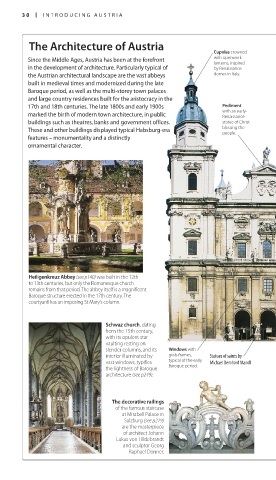
Heiligenkreuz Abbey (see p140) was built in the 12th
to 13th centuries, but only the Romanesque church
remains from that period. The abbey itself is a magnificent
Baroque structure erected in the 17th century. The
courtyard has an imposing St Mary’s column.
Schwaz church, dating
from the 15th century,
with its opulent star
vaulting resting on
slender columns, and its Windows with
interior illuminated by grab-frames, Statues of saints by
vast windows, typifies typical of the early Michael Bernhard Mandl
the lightness of Baroque Baroque period.
architecture (see p249).
The decorative railings
of the famous staircase
at Mirabell Palace in
Salzburg (see p219)
are the masterpiece
of architect Johann
Lukas von Hildebrandt
and sculptor Georg
Raphael Donner.
030-031_EW_Austria.indd 30 12/09/17 3:02 pm

