


Page 280 - (DK Eyewitness) Travel Guide - Austria
P. 280
278 A USTRIA REGION B Y REGION
9 Friesach region’s settlement
date from Celtic times.
Road map E5. * 5,000. £ @
n Fürstenhofplatz 1 (04268) 2213-40. In the small old town,
Stadtpfarrkirche St
Friesach is Carinthia’s oldest Jakob (parish church of
town, with a history going back St Jacob) was built after a
to 860, when the nearby fortress powerful earthquake in
of Petersberg was founded. 1348, and later rebuilt. Its
Traces of the town’s glorious most notable features are
past have survived to this day, the Renaissance chapels
including a moated town wall, of the Görz-Dietrichstein
820 m (2,690 ft) long, and and the Khevenhüller
several castle towers. Of the families and the 95-m-
fortress itself, only the six-storey (312-ft-) high tower.
keep on Petersberg survives. The Municipal Museum
In the former chapel room, on (open May–Oct) in a
the fourth floor, the remains 16th-century building at
of 12th-century frescoes can No. 38 Widmanngasse,
be seen. covers regional history, Schloss Porcia’s galleries, Spittal an der Drau
Adjacent to the fortress archaeology and art. In
is Peterskirche (church of Schillerpark you can see Salamanca. The Porcia family,
St Peter), which has a Gothic an astonishing 3D-map of who owned the palace from
altar (1525) with a Romanesque Carinthia, at a scale of 1:10,000. 1662 until 1918, added to its
statue of the Madonna (c.1200). decor while preserving the
The Dominikanerkloster Environs: Lovely 14th-century original architecture based on
(Dominican abbey) from 1217 frescoes and a late-Gothic altar Spanish Renaissance palaces.
holds a 14th-century Madonna, (c.1520) can be seen in the Its most beautiful aspect is the
a wooden crucifix (1300) and church of Maria Gail, 3 km galleried inner courtyard; be
other medieval artifacts. The (2 miles) southeast of Villach. sure to have a close look at the
church of St Blaise, built by the rich decorations of its individual
Teutonic Knights in 1213 on w Spittal an storeys. The well-preserved
the ruins of an earlier church, palace now houses a museum
has some original 12th- der Drau of folk art on the two top floors.
century frescoes. Road map D5. * 16,000. £ @
n Schloss Porcia, Burgplatz 1, Environs: On a hill near the
0 Around (04762) 5650220. village of St Peter in Holz, 5 km
Wörthersee The town of Spittal is domi nated (3 miles) northwest of Spittal an
der Drau, stand the ruins of an
See pp280–81. by the Goldeck peak (2,142 m/ early-Christian church and the
7,028 ft). The history of the town Römermuseum Teurnia (open
began in the 12th century, when May–Oct). The hill was settled
q Villach Count Ortenburg founded a first by Celts, then by Romans,
church and a Spittal, or hospice and the museum exhibits many
Road map E5. * 60,000. £ @
n Bahnhofstrasse 3, (04242) 205 2900. on this site. The town owes small items, scripts and coins.
its Renaissance character to
Carinthia’s second largest town the vast 16th-century Schloss
is an important tourist centre, Porcia, which is also known as e Millstatt
health resort and transport hub. Salamanca Palace after its builder, Road map D5. * 3,400. @ n
The earliest archaeological the Spanish nobleman Rathaus, Marktplatz 8, (04766) 202 10.
finds testifying to the Gabriel of ∑ millstatt.at
The greatest attraction in
Millstatt, on the northern
shore of Millstätter See, is a
Benedictine abbey dating
from 1070. From then until
1469 it was run by the Hirsau
Benedictines; later the
monastery and church passed
into the hands of the Order of
the Knights of St George, and
from 1598 until 1773 it was
owned by the Jesuits. The most
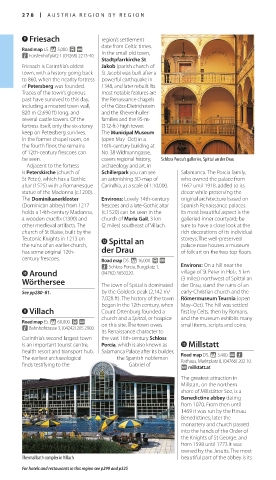
Thermal bath complex in Villach beautiful part of the abbey is its
For hotels and restaurants in this region see p299 and p325
278-279_EW_Austria.indd 278 12/09/17 3:05 pm
Eyewitness Travel LAYERS PRINTED:
Catalogue template “UK” LAYER
(Source v2.1)
Date 5th December 2012
Size 125mm x 217mm

