


Page 35 - (DK Eyewitness) Travel Guide - Austria
P. 35
A POR TR AIT OF A USTRIA 33
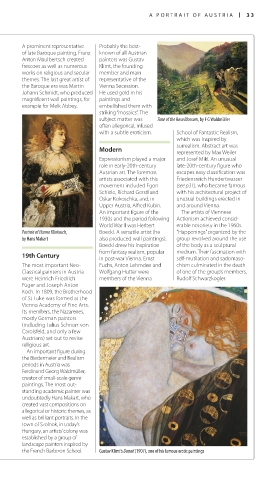
A prominent representative Probably the best-
of late Baroque painting, Franz known of all Austrian
Anton Maulbertsch created painters was Gustav
frescoes as well as numerous Klimt, the founding
works on religious and secular member and main
themes. The last great artist of represen tative of the
the Baroque era was Martin Vienna Secession.
Johann Schmidt, who produced He used gold in his
magnificent wall paintings, for paintings and
example for Melk Abbey. embellished them with
striking “mosaics”. The
subject matter was Time of the Rose Blossom, by F G Waldmüller
often allegorical, infused
with a subtle eroticism. School of Fantastic Realism,
which was inspired by
surrealism. Abstract art was
Modern
represented by Max Weiler
Expressionism played a major and Josef Mikl. An unusual
role in early-20th-century late-20th-century figure who
Austrian art. The foremost escapes easy classification was
artists associated with this Friedensreich Hundertwasser
movement included Egon (see p31), who became famous
Schiele, Richard Gerstl and with his architectural project of
Oskar Kokoschka, and, in unusual buildings erected in
Upper Austria, Alfred Kubin. and around Vienna.
An important figure of the The artists of Viennese
1930s and the period following Actionism achieved consid-
World War II was Herbert erable notoriety in the 1960s.
Portrait of Hanna Klinkosch, Boeckl. A versatile artist (he “Happenings” organized by the
by Hans Makart also produced wall paintings), group revolved around the use
Boeckl drew his inspiration of the body as a sculptural
from fantasy realism, popular medium. Their fascination with
19th Century
in post-war Vienna. Ernst self-mutilation and sadomaso-
The most important Neo- Fuchs, Anton Lehmden and chism culminated in the death
Classical painters in Austria Wolfgang Hutter were of one of the group’s members,
were Heinrich Friedrich members of the Vienna Rudolf Schwarzkogler.
Füger and Joseph Anton
Koch. In 1809, the Brotherhood
of St Luke was formed at the
Vienna Academy of Fine Arts.
Its members, the Nazarenes,
mostly German painters
(including Julius Schnorr von
Carolsfeld, and only a few
Austrians) set out to revise
religious art.
An important figure during
the Biedermeier and Realism
periods in Austria was
Ferdinand Georg Waldmüller,
creator of small-scale genre
paintings. The most out-
standing academic painter was
undoubtedly Hans Makart, who
created vast compositions on
allegorical or historic themes, as
well as brilliant portraits. In the
town of Szolnok, in today’s
Hungary, an artists’ colony was
established by a group of
landscape painters inspired by
the French Barbizon School. Gustav Klimt’s Danaë (1907), one of his famous erotic paintings
032-033_EW_Austria.indd 33 12/09/17 3:02 pm

