


Page 360 - (DK Eyewitness) Travel Guide - Austria
P. 360
358 SUR VIV AL GUIDE
Getting Around Towns the first hour. Bikes may also be
hired from some stations, at a
Austria has an excellent urban public transport system. Most discount if you have a train
towns generally have a network of buses and, in most cities, ticket. In Vienna, bike paths
trams. Vienna also has an underground subway (U-Bahn) – the take you around the Ringstrasse
quickest way to reach any destination. One type of ticket can and past many of the sights.
be used across the transport system, and tickets for unlimited One of the most scenic long-
distance cycling routes is the
travel for specific time periods can be purchased. One-way Radweg (cycle track) along the
traffic systems and pedestrianized areas make driving more Danube river.
troublesome than using trams and buses, or setting out on
foot. Especially in historic, compact city centres, where most Taxis
of the main sights are to be found, walking is the most
efficient and satisfying mode of transport. Taxis throughout Austria are
generally of a high standard and
very safe. Thanks to the
Walking comprehensive public
Pedestrians have priority, even transport systems,
on roads – but you should never however, taxis are gen-
rely on this. Try to use subways er ally used not for daily
or crossings where there are transport around town
signals, especially when but for trips to airports
crossing wide roads with fast- or train stations. Fares
moving traffic. Visitors should to the airport are usually
note that motorists drive on the fixed, with a 10 per cent
right. Do not cross a road when tip expected. A ride to
the red signal shows, even if the airport from central
there is no traffic – you may Vienna, for example,
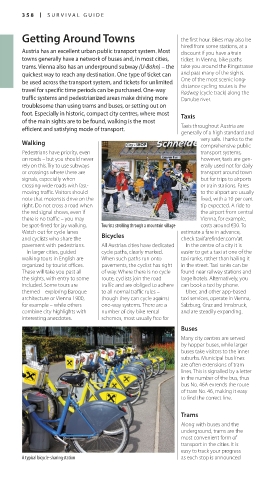
be spot-fined for jay walking. Tourists strolling through a mountain village costs around €30. To
Watch out for cycle lanes Bicycles estimate a fare in advance,
and cyclists who share the check taxifarefinder.com/at.
pavement with pedestrians. All Austrian cities have dedicated In the centre of a city it is
In larger cities, guided cycle paths, clearly marked. easier to get a taxi at one of the
walking tours in English are When such paths run onto taxi ranks, rather than hailing it
organized by tourist offices. pavements, the cyclist has right in the street. Taxi ranks can be
These will take you past all of way. Where there is no cycle found near railway stations and
the sights, with entry to some route, cyclists join the road large hotels. Alternatively, you
included. Some tours are traffic and are obliged to adhere can book a taxi by phone.
themed – exploring Baroque to all normal traffic rules – Uber, and other app-based
architecture or Vienna 1900, though they can cycle against taxi services, operate in Vienna,
for example – while others one-way systems. There are a Salzburg, Graz and Innsbruck,
combine city highlights with number of city bike rental and are steadily expanding.
interesting anecdotes. schemes, most usually free for
Buses
Many city centres are served
by hopper buses, while larger
buses take visitors to the inner
suburbs. Municipal bus lines
are often extensions of tram
lines. This is signalled by a letter
in the number of the bus, thus
bus No. 46A extends the route
of tram No. 46, making it easy
to find the correct line.
Trams
Along with buses and the
underground, trams are the
most convenient form of
transport in the cities. It is
easy to track your progress
A typical bicycle-sharing station as each stop is announced
358-359_EW_Austria.indd 358 12/09/17 2:46 pm

